The Wyvernwood Garden Apartments, a large-scale low-rise development opened in 1939, are at the center of a preservation debate. Lauren Walser gives us the case for keeping them.


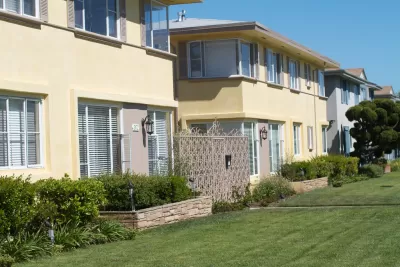
Built according to Ebenezer Howard's Garden City model, the Wyvernwood development in East Los Angeles now houses a majority-Latino community. Lauren Walser writes, "Each of the 143 buildings is built around grassy garden areas, so that residents walk out their front door and into a park-like setting, rather than a busy street. The buildings, minimalist in design with low-pitched roofs, are positioned to let it plenty of sunlight and fresh air, while still giving each unit a sense of privacy."
"Since 2007, the residents of Wyvernwood have been fighting its demolition. The complex's owner, Miami-based Fifteen Group Land and Development LLC, has proposed to level Wyvernwood and replace it with a $2 billion development."
The article quotes Adrian Scott Fine, director of advocacy at the Los Angeles Conservancy. "'There's a housing crisis in Los Angeles, no question about that,' Fine says. 'And we need to address it. But we want to look for a win-win opportunity, where we can create some density without total destruction and loss. There's an opportunity for change, but how do you manage change in a way that doesn't call for a complete loss of community?'"
FULL STORY: The Fight to Save Wyvernwood, L.A.'s First Large-Scale Garden Apartment


Why L.A.'s Boyle Heights Matters to Anti-Gentrification Activists
The historically Latino working class neighborhood is a frequent touchstone in debates over gentrification in Los Angeles. That history goes back decades and colors residents' perceptions.
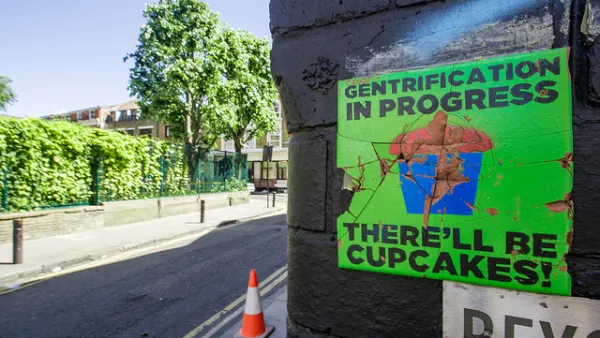
Lessons for YIMBYs From Boyle Heights
In the wake of a very pro-development March election, Los Angeles seems ready to embrace change. But not everywhere. In low-income Boyle Heights, residents have been more militant than most against encroaching gentrification.
East Los Angeles Community Groups Prove that Community Planning Matters
The landscape of community development in Los Angeles today differs vastly from even a few years ago. Two groups in East L.A. are developing solutions to accelerating gentrification and displacement and a compounding affordable housing crisis.

Planetizen Federal Action Tracker
A weekly monitor of how Trump’s orders and actions are impacting planners and planning in America.

The state-sanctioned urbicide of Austin
People don’t kill cities. Freeways do.

US to reduce Colorado River water deliveries to Mexico
A new Colorado Treaty amendment reduces Mexico’s Colorado River water allocation by 250,000 acre feet.

5 New England states march closer to 800 megawatt wind energy project
Securing federal approval for the project may be complicated under the Trump administration, which has historically been hostile towards domestic wind power.

Baltimore to break ground on $50 million Transit Priority Project
The project will bring faster bus trips, safer streets and better bike connections to Baltimore.

Airbnb launches $250 million 'last-dollar financing' housing accelerator, makes first investment in Austin
The company will put $6.4 million towards affordable housing development in Texas’ capital.

FREE Course: Walkable City 1: Why Walkability?
After describing his path towards focusing on walkability as the essence of good planning, Jeff Speck marches through his five principal reasons for making more walkable places.
Reinventing Malls: Planning Alchemy—Turning Gray Fields Into Gold
The course focuses on the opportunities and imperatives that shape reinvention of mall sites.

Eagle County Government
Harvard University Graduate School of Design
Nashville Planning Department
The Architects Foundation
University of Cincinnati Online
The Pocatello Development Authority
The Urban Renewal Agency of the City of Pocatello
Journal of the American Planning Association