For better or for worse, the tall, skinny towers that have helped to remake New York’s iconic skyline appear to be growing in popularity among developers.


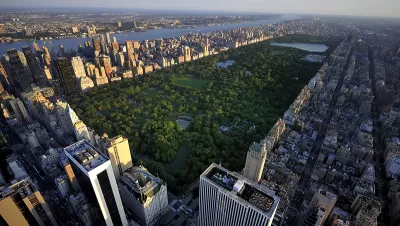
Matt A.V. Chaban of the New York Times reports on the skinny towers that have begun to sprout up around 56th and 57th streets, south of Central Park in what some have dubbed "Billionaires' Row." The new construction has seen the number of towers exceeding 1,000 feet jump from five to double that number in the past few years, with dozens more towers planned or under construction.
These slender cloud-busters would not have been built without the confluence of new technologies and wealthy buyers seeking a Manhattan address. Superstrong concrete and new wind testing made possible buildings like 432 Park, which, at 93 feet wide, is 15 times as tall as it is wide. In effect, developers now need only a lot the size of a brownstone or three to build a tower, rather than much of a block…
Opponents of the new towers believe developers are exploiting an out of date zoning code that allows for transfer of air rights. Chaban writes that opponents have complained that the new towers have led to overcrowding on subways and shadows falling on public spaces.
Read the full story: As a New High Society Climbs in Manhattan, It’s a Race to the Top
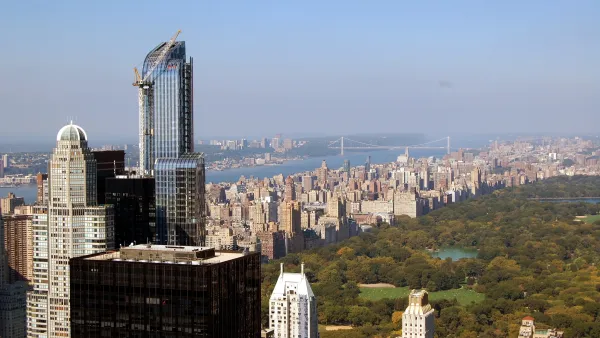
Billionaire Row's Newest Residents: Lawsuits and Foreclosures
The world's skinniest skyscraper, under construction on Manhattan "Billionaire's Row," is over budget with 60 stories left to build.
The Sun Also Hides Behind Skyscrapers
The Washington Post details the concern over the shadows cast by skyscrapers on the city street below. The latest high-profile case study of the ability of skyscrapers to block the sun: New York's Midtown.
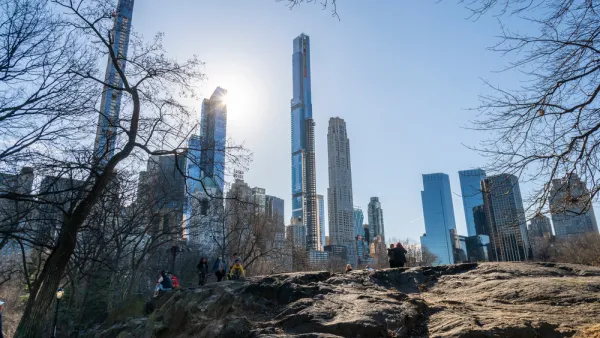
World's Tallest Residential Building Nears Completion in Manhattan
Central Park Tower, coming soon to New York City's "Billionaires' Row" was designed by Adrian Smith + Gordon Gill architecture.

Planetizen Federal Action Tracker
A weekly monitor of how Trump’s orders and actions are impacting planners and planning in America.

California plans to bury El Niño’s downpour
If the state plays its cards right, it may be able to store a billion acre-feet of El Niño’s water in aquifers.

Desperate measures: Advocates weigh draining Lake Powell to fill Colorado River
Draining the reservoir could reduce evaporation losses by a couple hundred thousand acre-feet.

Los Angeles just elected an urban planner as its mayor
Transportation analysts are optimistic that Raman will be more aggressive in addressing transit issues than Bass.

Mamdani’s pied-à-terre tax survives legal challenge
A panel of judges found that the plaintiffs failed to demonstrate injury as a result of New York City's implementation of the tax.

Eastern Nebraska is running out of electricity
Data centers and electrification are straining eastern Nebraska’s grid, throttling economic development.

FREE Course: Walkable City 1: Why Walkability?
After describing his path towards focusing on walkability as the essence of good planning, Jeff Speck marches through his five principal reasons for making more walkable places.
Reinventing Malls: Planning Alchemy—Turning Gray Fields Into Gold
The course focuses on the opportunities and imperatives that shape reinvention of mall sites.

City of Rosemead
Rutgers University, Edward J. Bloustein School of Planning and Public Policy
One Hundred Miles
University of Michigan School for Environment and Sustainability (SEAS)
Hunter College, City University of New York (CUNY)
The Architects Foundation
City of Cambridge
Montrose County
The Pocatello Development Authority