New pilot projects authorized by the FAST Act include allowing private operators to bid on operating three of Amtrak's 15 long-distance lines for up to eight years "provided they reduce the need for taxpayer support" and allowing pets on trains.


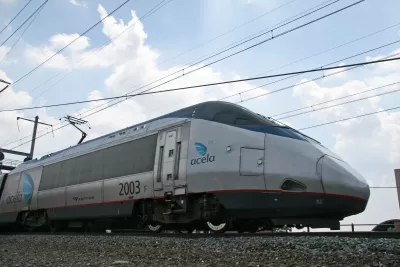
Among the changes in the five-year Fixing America’s Surface Transportation (FAST) Act that was signed by President Obama on December 4 are these two Amtrak pilot projects. First, allowing private rail operators to bid on long distance routes (PDF) that some say will "likely will always lose money":
"(P)otential competitors would submit an operating plan that includes steps to reduce taxpayer operating subsidies by 10% or more, while at least matching Amtrak’s performance," writes Andrew Tangel for The Wall Street Journal. If they "took over some Amtrak routes, it would mark a significant shift in how America’s national passenger railroad has been run since the federal government created it in 1970."
Private operators have already penetrated the commuter rail sector. "Herzog Transit Services Inc. operates Caltrain in the San Francisco Bay area (and) Transdev North America Inc. [formerly Veolia Transportation] runs the Tri-Rail line in South Florida," notes Tangel.
For fiscal 2015, which ended Sept. 30, Amtrak said the Northeast Corridor generated $479 million in adjusted operating surpluses, while its long-distance lines lost $495 million. Its state-supported routes, which generally run under 750 miles, reported $96 million in operating losses.
“I’m not sure what kind of interest we’re going to get from private-sector partners in this,” said Robert Puentes, a senior fellow at the Brookings Institution.
Joseph Boardman, Amtrak’s president and chief executive, expressed doubts competitors would wind up taking over the lines. He noted the steep expenses associated with running long-distance trains, including staffing the dining cars, refueling and sewer and water service.
Another pilot project authorized by the FAST Act will strike close to home for pet lovers. They have Rep. Jeff Denham (R-Madera, Calif.), no friend of California high-speed rail, to thank, or more precisely, his 15 pound French bulldog, Lily, according to Jennifer Scholtes, transportation reporter for POLITICO Pro.
Amtrak will have to dedicate at least one “pet car” on each train, where feasible, to allow passengers to transport kenneled pets either as carry-on or checked luggage. The rail operator is barred from using any federal funds to operate the program and is instead required to charge an extra pet fee to cover the cost.
He and Lily have been trying since 2013 to make Amtrak pet-friendly.
"Little-heralded changes" in the FAST Act are the focus of a New York Times piece, including changes to the 1998 interstate tolling pilot project.
Hat tip: Mark Boshnack
Read the full story: Amtrak Faces Prospect of Private Competition

How Virginia Became a Leader in Passenger Rail
The state's consistent investment in passenger rail has resulted in one of the nation's most effective regional rail networks.

Funding Approved for Key Rail Connection Between New Jersey and New York
The Portal Bridge is a key component of the larger Gateway Program that includes tunnels under the Hudson River. Fixing the Portal Bridge across the Hackensack River will provide tremendous relief to NJ Transit and Amtrak commuters.
Loss of SEPTA Funding Could Kill Amtrak’s Fifth Busiest Line
The Philadelphia transit agency’s funding challenges could eliminate its contributions to Amtrak’s Keystone Service linking Philly and NYC.

Planetizen Federal Action Tracker
A weekly monitor of how Trump’s orders and actions are impacting planners and planning in America.

Amtrak, CN end decades-long dispute with eight-year agreement
The new operating agreement establishes an updated framework for the companies to work together, including processes to resolve disputes.

Northwest rail fans eager for Sept. 30 debut of Amtrak’s Airo fleet
Get ready for that new train smell and more seats. But they won’t go faster or run more frequently on the Cascades route in Washington and Oregon.

Trump administration unlawfully slashed $7 billion in clean energy grants, judge rules
The Environmental Protection Agency ended the Solar For All program, which provided the grants, after President Donald Trump’s inauguration.

Record-breaking wildlife overpass in Colorado brings 91% reduction in animal collisions
Prior to the overpass, vehicles were hitting one deer per day on Colorado’s Interstate 25.

California lawmakers approve just 5% of much-needed LA28 transportation funding
State legislators appear just as unwilling as Trump to pay for Olympics-related transportation projects.

FREE Course: Walkable City 1: Why Walkability?
After describing his path towards focusing on walkability as the essence of good planning, Jeff Speck marches through his five principal reasons for making more walkable places.
Reinventing Malls: Planning Alchemy—Turning Gray Fields Into Gold
The course focuses on the opportunities and imperatives that shape reinvention of mall sites.

City of Thousand Oaks
City of Wisconsin Rapids
Harvard University Graduate School of Design
The Architects Foundation
University of Cincinnati Online
The Pocatello Development Authority
The Urban Renewal Agency of the City of Pocatello