How well do public spaces reflect the changing conceptions of "public good" in contemporary political discourse? The UPenn design community starts a challenging conversation.


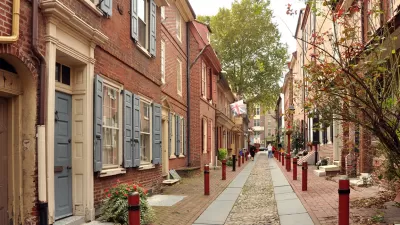
PennPraxis, a design collaborative spawned by faculty and students of University of Pennsylvania's design school, will begin a program called the Praxis Dialogues, in partnership with PlanPhilly. The series of conversations will begin with an exploration of the public good and its meaning for the design community. The program is free and open to the public.
From the PlanPhilly blog:
"We are all, in some manner, motivated by public good...Public good in a full sense challenges us to envision shared spaces as not just those leftover once private goods are consumed. How does our shared, “public” realm express and live up to our political and social ideals? We owe it to ourselves, our collaborators, and our fellow citizens to be explicit about this ideal – and to be candid in our evaluation of how we succeed or fail to realize it."
Recognizing the public good as a political concept, the questions posed are challenging and will address such timely issues as access, stewardship, ownership, and cultural confidence. The emphasis will be on practice rather than lofty abstractions. "Ideas of public good are changeful, reflections of the politics of a moment. The current moment is messy."
Questions posed will also address the public good with respect specifically to Philadelphia and its current political environment.
Read the full story: Praxis Dialogues: The 'public good' in practice
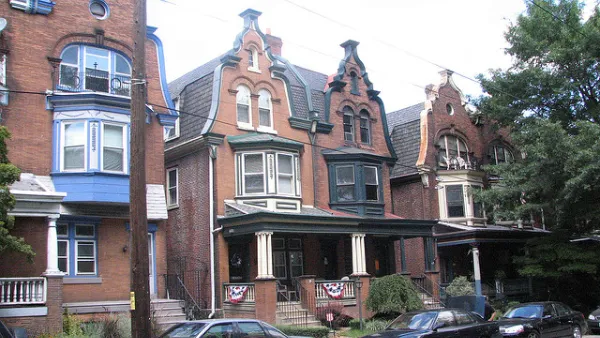
New Zoning in Historic Philadelphia Neighborhood Will Protect Victorian Homes
A rezoning expected to go into effect in the neighborhood of Spruce Hill in Philadelphia chooses historic preservation over potential student housing developments.
Celebrating a Decade of Progressive Planning in Philly
On the tenth anniversary of the founding of PennPraxis, Tom Stoelker looks at the consultancy's contribution to advancing community-based planning, and several crucial projects, in Philadelphia.
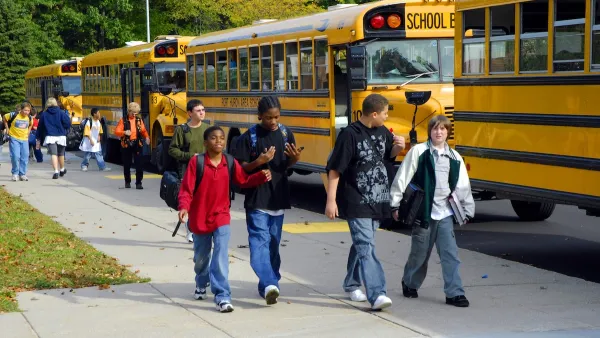
Learning loss and urban schools, part 2
Did test scores in progressive cities drop more post-COVID than test scores in moderate ones?

Desperate measures: Advocates weigh draining Lake Powell to fill Colorado River
Draining the reservoir could reduce evaporation losses by a couple hundred thousand acre-feet.

Eastern Nebraska is running out of electricity
Data centers and electrification are straining eastern Nebraska’s grid, throttling economic development.

Move over, LA: St. Louis gears up for Olympics, invests millions in downtown redevelopment
The Missouri city will host the 2028 Olympic soccer group stage and knockout matches.

Mass. votes against statewide minimum lot size for single-family homes
Over 2 million residents voted on Question 7; it was decided by just over 30,000 votes.

Maryland’s $15 billion bridge project gains key approval
The Maryland Transit Authority said the project will create over 60,000 jobs and add $23 billion to the local economy.

‘No clear next steps’ for Chicago's permanent festival grounds
Eleventh Ward Ald. Nicole Lee has suggested Soldier Field as a possible location for the permanent event space.

FREE Course: Walkable City 1: Why Walkability?
After describing his path towards focusing on walkability as the essence of good planning, Jeff Speck marches through his five principal reasons for making more walkable places.
Reinventing Malls: Planning Alchemy—Turning Gray Fields Into Gold
The course focuses on the opportunities and imperatives that shape reinvention of mall sites.

City of Rosemead
Rutgers University, Edward J. Bloustein School of Planning and Public Policy
One Hundred Miles
University of Michigan School for Environment and Sustainability (SEAS)
Hunter College, City University of New York (CUNY)
The Architects Foundation
City of Cambridge
The Pocatello Development Authority
The Urban Renewal Agency of the City of Pocatello