A 1.5-acre park in Cleveland should be ready in time for the 2016 Republican National Convention. The small park is just the first step, however, toward a much grander vision for a corner of Cleveland with deep connections to the city's past.


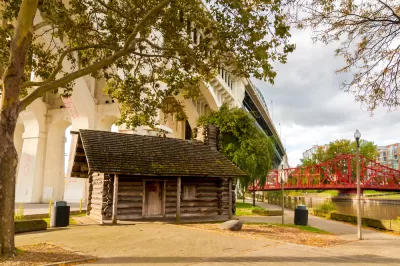
The first step toward a grand vision for the Canal Basin Park is underway in Cleveland. Steven Litt reports about the current planning for a park project on 1.5 acres of what will eventually become 20 acres of ambitiously designed park space.
The 1.5-acre park currently underway with planning will be "located near the intersection of Center Street and Merwin Avenue on the east bank of the Flats," reports Litt. For now, Cleveland Metroparks will use $300,000 in tax increment financing to "install grass, walking paths and trees on the 1.5-acre parcel, connecting Columbus Road and Center Street down to Heritage Park on Cuyahoga River." A parking lot will also be removed.
Litt notes that the park's location "may be obscure geography to some Clevelanders, but it wasn't in the past and won't be in the future." And the future, signified by the plans for Canal Basin Park, could be on its way much faster now. The city's Planning Commission scheduled to review the park's framework plan later in November.
The name Canal Basin indicates the site's importance in Cleveland history. As Litt notes, the "larger park will mark the northern terminus of the 110-mile Towpath Trail, and focus fresh attention on the original northern end of the Ohio & Erie Canal, completed in 1832."
Read the full story: Metroparks plans "greening" for 1.5-acres of the future 20-acre Canal Basin Park (photos)
Not a Walk in the Park: What It Really Takes to Build Green Spaces
Park creation can take decades of perseverance to overcome financial, regulatory, and social hurdles, but the end result for the local community is more than worth it.
Envisioning a New Park in East Los Angeles
Los Angeles County is working towards transforming underutilized land into a vibrant pocket park in the City Terrace neighborhood of East LA.

Using Cellphone and Fitness App Data for Park Planning
Data from smartphone apps and fitness trackers are helping planners to better understand park usage patterns and plan for new and improved parks.

Planetizen Federal Action Tracker
A weekly monitor of how Trump’s orders and actions are impacting planners and planning in America.

California plans to bury El Niño’s downpour
If the state plays its cards right, it may be able to store a billion acre-feet of El Niño’s water in aquifers.

Desperate measures: Advocates weigh draining Lake Powell to fill Colorado River
Draining the reservoir could reduce evaporation losses by a couple hundred thousand acre-feet.

Mamdani’s pied-à-terre tax survives legal challenge
A panel of judges found that the plaintiffs failed to demonstrate injury as a result of New York City's implementation of the tax.

Eastern Nebraska is running out of electricity
Data centers and electrification are straining eastern Nebraska’s grid, throttling economic development.

Seattle passes record-breaking transit services expansion
Proposition 1 will double the city’s transit tax to add 95,000 more bus trips and preserve 180,000 bus trips annually.

FREE Course: Walkable City 1: Why Walkability?
After describing his path towards focusing on walkability as the essence of good planning, Jeff Speck marches through his five principal reasons for making more walkable places.
Reinventing Malls: Planning Alchemy—Turning Gray Fields Into Gold
The course focuses on the opportunities and imperatives that shape reinvention of mall sites.

City of Rosemead
Rutgers University, Edward J. Bloustein School of Planning and Public Policy
One Hundred Miles
University of Michigan School for Environment and Sustainability (SEAS)
Hunter College, City University of New York (CUNY)
The Architects Foundation
City of Cambridge
Montrose County
The Pocatello Development Authority