K-12 geography proficiency has not improved since 1994.


The U.S. Government Accountability Office (GAO) released an important report last week that underscores the need for funding K-12 geography education in the United States. The Association of American Geographers (AAG) provided substantial input to GAO during their process of developing this report.
"The GAO report is another clarion call for the need to support geography education in the U.S.," said AAG Executive Director Douglas Richardson. "Geography is integral to nearly all aspects of life today, ranging from our economy to our foreign policy."
AAG President Sarah Bednarz added, “This important and timely study reinforces our efforts to promote the importance of K-12 geography education in preparing American students for rapidly-growing job fields.”
The report includes a U.S. Department of Labor projection that the employment of specialists in geography, or geographers, is expected to grow 29 percent from 2012 to 2022—much faster than the average 11 percent growth for all occupations.
According to a statement from GAO, "The growing use of geographic information and location-based technology across multiple sectors of the American economy has prompted questions about whether K-12 students' skills and exposure to geography are adequate for current and future workforce needs." GAO conducted this study pursuant to a provision outlined in Senate Report 113-71, which calls for "GAO to report on the status of geography education and challenges elementary and secondary schools face in providing geography education with limited resources."
The report's cover letter to U.S. Senators Roy Blunt and Patty Murray emphasized that, "Geographic information and geospatial, or location-based, technologies are growing sectors of the American economy, influencing almost every facet of modern life, from tracking lost cell phones to monitoring disease outbreaks like Ebola. The emergence of these technologies has increased demand for workers who can analyze and interpret geographic information. Research suggests that K-12 education is critically important for learning the fundamentals of geography, which is the study of places and the relationship between people and their environment."
The study's findings validate the importance of the AAG Resolution Supporting K-12 Geography Education, which demonstrates the need for funding for K-12 geography as part of the reauthorization of the Elementary and Secondary Education Act. The resolution has been endorsed by four former U.S. Secretaries of State; four former Defense Secretaries; 24 bipartisan incumbent Governors; and over 25 Fortune 500 companies. It can be accessed at: http://www.aag.org/resolution.
FULL STORY: AAG Newsletter

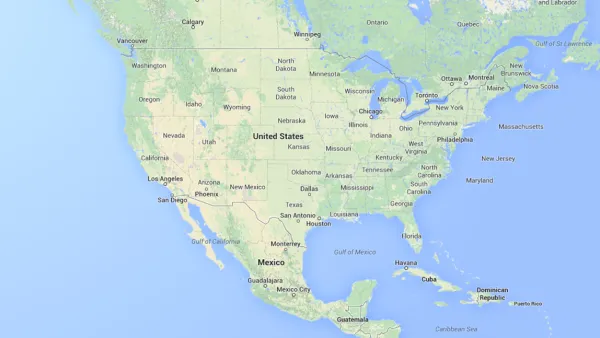
The Importance of Geographic Literacy
Maps are still an important tool in teaching kids to be global citizens.

Geographers Aren’t Going Anywhere
Microsoft says AI renders my profession obsolete. They couldn’t be more wrong.

A Better Way to Plan School Facilities
Taking a wider view of communities could help keep schools open despite falling enrollment.

Planetizen Federal Action Tracker
A weekly monitor of how Trump’s orders and actions are impacting planners and planning in America.

The state-sanctioned urbicide of Austin
People don’t kill cities. Freeways do.

US to reduce Colorado River water deliveries to Mexico
A new Colorado Treaty amendment reduces Mexico’s Colorado River water allocation by 250,000 acre feet.

5 New England states march closer to 800 megawatt wind energy project
Securing federal approval for the project may be complicated under the Trump administration, which has historically been hostile towards domestic wind power.

Baltimore to break ground on $50 million Transit Priority Project
The project will bring faster bus trips, safer streets and better bike connections to Baltimore.

Airbnb launches $250 million 'last-dollar financing' housing accelerator, makes first investment in Austin
The company will put $6.4 million towards affordable housing development in Texas’ capital.

FREE Course: Walkable City 1: Why Walkability?
After describing his path towards focusing on walkability as the essence of good planning, Jeff Speck marches through his five principal reasons for making more walkable places.
Reinventing Malls: Planning Alchemy—Turning Gray Fields Into Gold
The course focuses on the opportunities and imperatives that shape reinvention of mall sites.

Eagle County Government
Harvard University Graduate School of Design
Nashville Planning Department
The Architects Foundation
University of Cincinnati Online
The Pocatello Development Authority
The Urban Renewal Agency of the City of Pocatello
Journal of the American Planning Association