An editorial favors one local city's approach to mansionization over another's. When will they ever learn?


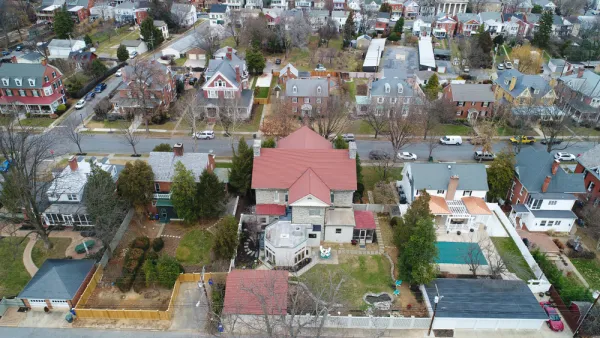
It's almost like the Great Recession never happened in the San Gabriel Valley of Southern California: homeowners, developers, and international investors are tearing down single-family detached homes and replacing them with much larger single-family detached homes.
The editorial board of the Pasadena Star-News chimed in on the reignited controversy over mansionization in the cities of San Gabriel and Arcadia. "The city of San Gabriel last month became the latest in the region to begin to investigate solutions to the problems of mansionization in the region, and good for it," begins the editorial. Meanwhile, according to the editorial, nearby Arcadia is sticking its head in the "construction dirt."
So the editorial performs a compare and contrast on the two cities' approach to mansionization pressures. The right way, according to the editorial, as embodied by San Gabriel:
"Quite properly, the main focus in the short run in San Gabriel is on updating its outmoded housing preservation ordinance to protect the excellent stock of appropriately scaled pre-World War II residential neighborhoods in the city. But city leaders are also not shying away from considering a temporary moratorium on the razing of single-family houses in order to build McMansions while it gets its planning act together."
Meanwhile in Arcadia, "an out-of-touch three-member City Council majority has blocked a zoning study that had appropriately been under way…"
Courtney Tompkins, staff reporter for the Pasadena Star-News, reported on the initial findings of the city of San Gabriel's study back in September. For another take on the mansionization controversy, a letter to the editor by George Carney, resident of San Gabriel, says "the furor about 'mansionization' [is] just the latest sad commentary on the reactionary and bigoted thinking of all too many San Gabriel residents."
FULL STORY: San Gabriel plans for an appropriately scaled future: Editorial


Luxury Condos, Not Luxury Single-Family Homes, Take the Blame in the Affordability Debate
An article in The Urbanist suggests the ire over new developments is misplaced.
McMimpact Fee Proposed
Should there be an extra fee for property owners who tear down an existing single-family home and replace it with a much larger, more expensive single-family home?

Discretionary Approval for McMansions
Redwood City, located on the San Francisco Peninsula, will make it harder to build homes that take up more than 45 percent of a residential lot.

The state-sanctioned urbicide of Austin
People don’t kill cities. Freeways do.

US to reduce Colorado River water deliveries to Mexico
A new Colorado Treaty amendment reduces Mexico’s Colorado River water allocation by 250,000 acre feet.

New Jersey’s second-largest city bans standalone data centers
Jersey City will continue to allow co-location facilities, such as those meant for research institutions that store their own data.

Amtrak not solely to blame for New Jersey commuter rail's unreliability, report finds
A new study from the Garden State Initiative found that NJ Transit’s budget grew 20% across a 4 year period, but reliability declined significantly over the same period.

EPA erases limits on planet-warming pollution from power plants
Under Monday’s plan, power plants would still have some limits on how much mercury, arsenic and other contaminants they can emit.

Phoenix announces new on-demand transit service, more frequent RAPID buses
Both new services will launch in October, and are part of Phoenix's Project Effective Access Solutions for Easing Congestion.

FREE Course: Walkable City 1: Why Walkability?
After describing his path towards focusing on walkability as the essence of good planning, Jeff Speck marches through his five principal reasons for making more walkable places.
Reinventing Malls: Planning Alchemy—Turning Gray Fields Into Gold
The course focuses on the opportunities and imperatives that shape reinvention of mall sites.

Eagle County Government
Harvard University Graduate School of Design
Nashville Planning Department
The Architects Foundation
University of Cincinnati Online
The Pocatello Development Authority
The Urban Renewal Agency of the City of Pocatello
Journal of the American Planning Association