Unsurprisingly, an editorial titled "Gentrify East New York" provoked a strong response from the public.


A Crain's editorial that sums up its proposed housing policy thusly: "Instead of relocating poor people to wealthy neighborhoods, attract wealthier people to poor ones." Noting that such a strategy is typically understood as gentrification, the op-ed points to other parts of the city as examples where such a process has been occurring naturally. The difference in the case study examined by the op-ed: "The de Blasio administration now hopes to jump-start this phenomenon in East New York, a forlorn area at the far end of Brooklyn that has missed out on the borough’s renaissance. On Sept. 21, the Department of City Planning will start a seven-month public review of its proposal to allow more housing in the low-scale, semi-industrial neighborhood." The op-ed is clear in its support of the policy—for East New York as well as other underachieving neighborhoods around the city.
Andrew J. Hawkins followed up by reporting on the responses provoked by the editorial, surveying soundbites from researchers, land use consultants, and anonymous Internet commenters. For instance, David Madden, as assistant professor of sociology at the London School of Economics and Political Science, tweeted that the op-ed was "All of the illusions and omissions of liberal urbanism distilled into one editorial."
Read the full story: Gentrify East New York

Explained: East New York's Big Zoning Changes
Some residents of East New York argue that mandatory inclusionary zoning and other changes proposed for the neighborhood will only help displace low-income residents.
Mayor de Blasio Stresses Affordable Housing in State of the City Address
In his State of the City Address on Feb. 3, the New York City mayor made it clear that his overriding priority is affordable housing. He targeted six neighborhoods in all five boroughs where development will be required to include affordable housing.
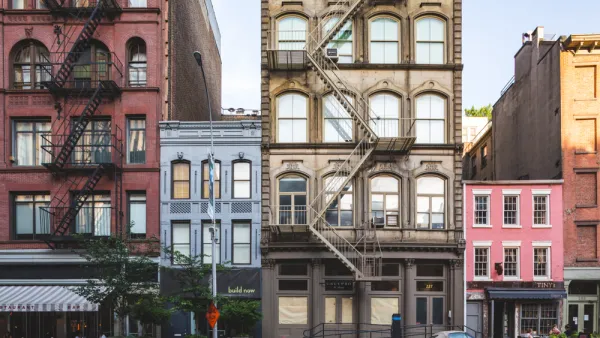
NoHo and SoHo Rezoning Controversies, Amplified
One of the big questions of planning is up for debate with a proposed rezoning in the SoHo and NoHo neighborhoods of New York City: Can upzoning be an effective tool for affordability?

Planetizen Federal Action Tracker
A weekly monitor of how Trump’s orders and actions are impacting planners and planning in America.

California plans to bury El Niño’s downpour
If the state plays its cards right, it may be able to store a billion acre-feet of El Niño’s water in aquifers.

Chicago breaks ground on $3 billion megadevelopment
The new neighborhood, titled Foundry Park, will one day host 3,700 residences.

California High-Speed Rail Authority CEO resigns after $600,000 scandal
Under Ian Choudri, the authority used taxpayer dollars to fund first class flights and trips to nightclubs.

Want to study the Missouri River? Soon, you may need unanimous approval from 10 states
Legislation would require 10 governors’ permission to study or build projects moving water outside the basin.

Desperate measures: Advocates weigh draining Lake Powell to fill Colorado River
Draining the reservoir could reduce evaporation losses by a couple hundred thousand acre-feet.

FREE Course: Walkable City 1: Why Walkability?
After describing his path towards focusing on walkability as the essence of good planning, Jeff Speck marches through his five principal reasons for making more walkable places.
Reinventing Malls: Planning Alchemy—Turning Gray Fields Into Gold
The course focuses on the opportunities and imperatives that shape reinvention of mall sites.

City of Rosemead
Rutgers University, Edward J. Bloustein School of Planning and Public Policy
One Hundred Miles
Hunter College, City University of New York (CUNY)
The Architects Foundation
University of Cincinnati Online
City of Cambridge
Montrose County
The Pocatello Development Authority