The city of Los Angeles is leveraging its hopes as the U.S. candidate to host the 2024 Olympics to ramp up rail construction to an "extremely aggressive" timetable.


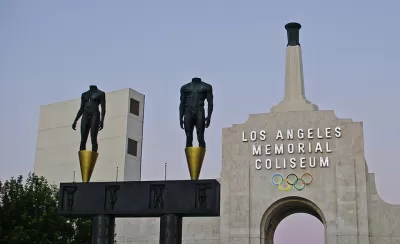
"Citing L.A.'s quest to host the 2024 Summer Olympics, Los Angeles County transportation officials are seeking to fast-track two of Metro's most anticipated rail projects," reports Laura J. Nelson.
"In letters sent Tuesday and obtained by The Times, the Metropolitan Transportation Authority formally asked to join a Federal Transit Administration pilot program that could accelerate construction on a subway to the Westside and a rail connection to Los Angeles International Airport."
The federal approval would, in effect, allow concurrent construction of the Purple Line (formerly known as the "Subway to the Sea") of all three planned phases. The article has more details about the construction of both lines, and how Los Angeles's Olympic ambitions might change the delivery horizon for the largest transit investments in the region.
Read the full story: Eyeing L.A.'s Olympic bid, Metro seeks to accelerate two rail projects
Purple Line Extension Gets $1.6 Billion Boost in Los Angeles
The Purple Line subway extension is picking up momentum in Los Angeles. With construction already underway on the first phase, the second phase should commence in 2018.
Los Angeles' Purple Line Moves Past Legal Opposition
A subway extension that would cut across the Los Angeles basin has cleared another legal hurdle, despite the efforts of a coalition of opponents in the city of Beverly Hills.
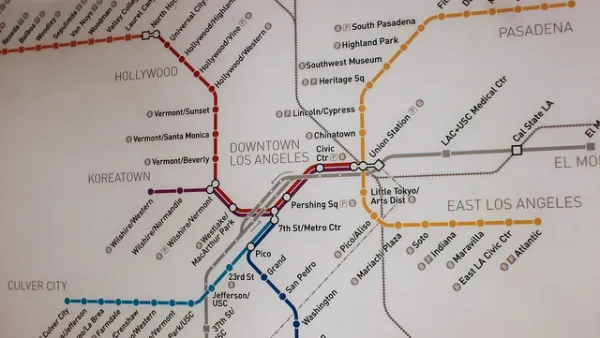
Los Angeles Breaks Ground on Purple Line Subway Extension
The long awaited groundbreaking for work on Los Angeles’s Purple Line Extension commenced. The project is expected to open in 2023.

Planetizen Federal Action Tracker
A weekly monitor of how Trump’s orders and actions are impacting planners and planning in America.

California plans to bury El Niño’s downpour
If the state plays its cards right, it may be able to store a billion acre-feet of El Niño’s water in aquifers.

Desperate measures: Advocates weigh draining Lake Powell to fill Colorado River
Draining the reservoir could reduce evaporation losses by a couple hundred thousand acre-feet.

Mamdani’s pied-à-terre tax survives legal challenge
A panel of judges found that the plaintiffs failed to demonstrate injury as a result of New York City's implementation of the tax.

Eastern Nebraska is running out of electricity
Data centers and electrification are straining eastern Nebraska’s grid, throttling economic development.

Seattle passes record-breaking transit services expansion
Proposition 1 will double the city’s transit tax to add 95,000 more bus trips and preserve 180,000 bus trips annually.

FREE Course: Walkable City 1: Why Walkability?
After describing his path towards focusing on walkability as the essence of good planning, Jeff Speck marches through his five principal reasons for making more walkable places.
Reinventing Malls: Planning Alchemy—Turning Gray Fields Into Gold
The course focuses on the opportunities and imperatives that shape reinvention of mall sites.

City of Rosemead
Rutgers University, Edward J. Bloustein School of Planning and Public Policy
One Hundred Miles
University of Michigan School for Environment and Sustainability (SEAS)
Hunter College, City University of New York (CUNY)
The Architects Foundation
City of Cambridge
Montrose County
The Pocatello Development Authority