The Massachusetts Bay Transportation Authority is scrambling to resolve a major cost overrun for the planned Green Line extension—in peril is potential rail service to one of the most densely populated cities in the country.


"The frequently delayed Green Line extension into Somerville and Medford could cost as much as $1 billion more than the Massachusetts Bay Transportation Authority’s budget estimates, raising doubts about whether the project will be completed," reports Nicole Dungca.
"MBTA officials on Monday revealed they may need between $700 million and $1 billion more — in addition to the current $1.99 billion price tag — to finish the project, which would create seven new stations and add about 4.7 miles of track to the trolley line."
Dungca quotes Transportation Secretary Stephanie Pollack saying that "everything is on the table" to bridge the shortfall in finding, including cancelling the project. The uncertain status of the project risks $1 billion in federal money awarded the project by the federal government in December. The line, if built, would serve one of the most densely populated cities in the country in Somerville. " When — and now if — the project is done, about 70 percent of residents in the city will be within walking distance of a rail station."
As for why the cost of the project was so drastically underestimated—Duncga cites Pollack again, who says that T officials estimated the cost of the new line based on the cost of large MBTA projects during the recession.
Read the full story: Green Line extension could cost another $1 billion

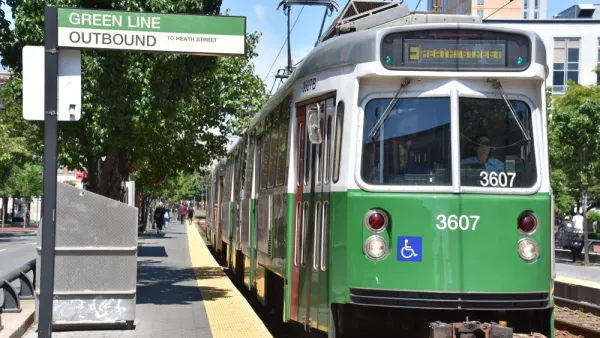
Potential Delays Trouble Boston Region's Green Line Extension Project
The Green Line extension will bring light rail service from Boston to Somerville and Medford, when it's done.
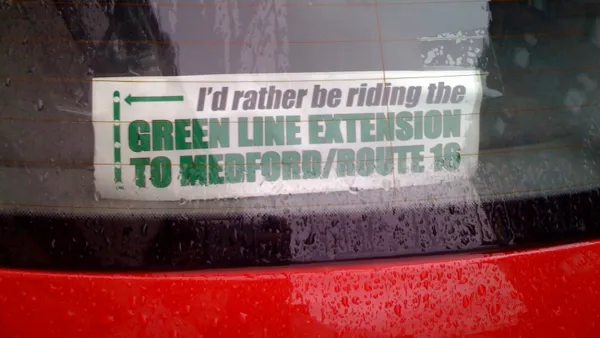
MBTA's Green Line Extension Moving Forward Again
A revised plan to extend the MBTA's Green Line light rail line into Somerville and Medford required approval from the state (approved last May) and the Federal Transit Authority (approved this week).
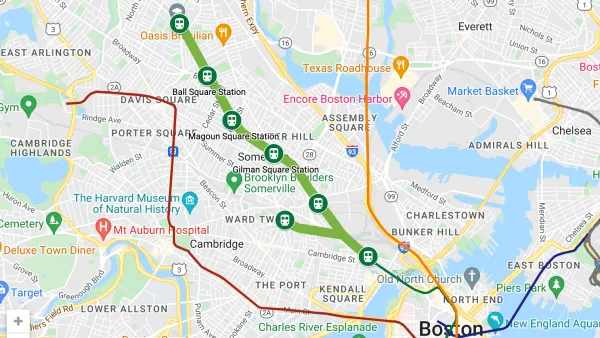
Long Awaited Green Line Extension Opens Today North of Boston
The Green Line Extension project, in the works for decades, is now providing rail transit service from Boston north into Somerville.

Planetizen Federal Action Tracker
A weekly monitor of how Trump’s orders and actions are impacting planners and planning in America.

Amtrak, CN end decades-long dispute with eight-year agreement
The new operating agreement establishes an updated framework for the companies to work together, including processes to resolve disputes.

Judges permit Denver to divert 77,000 acre feet from the Colorado River for reservoir expansion
Overuse and climate change have caused the Colorado River’s water levels to plummet.

NYC DOT wants faster, more permanent street upgrades
The city is examining ways to build more concrete infrastructure without getting entangled in 'decades-long' projects.

'Something we’ve never seen before:' rising utility rates could strain city finances nationwide
Data centers, climate change and other factors have caused utility rates in the United States to increase by 38% since 2020.

Trump to overrule local leaders, lease millions of acres of America’s Pacific Island territories’ seafloors to mining companies
International law says that the Indigenous people of America’s territories have a right to prior and informed consent regarding projects that impact their countries.

FREE Course: Walkable City 1: Why Walkability?
After describing his path towards focusing on walkability as the essence of good planning, Jeff Speck marches through his five principal reasons for making more walkable places.
Reinventing Malls: Planning Alchemy—Turning Gray Fields Into Gold
The course focuses on the opportunities and imperatives that shape reinvention of mall sites.

Harvard University Graduate School of Design
KFH Group Inc.
Greater Baltimore Committee
The Architects Foundation
University of Cincinnati Online
The Pocatello Development Authority
The Urban Renewal Agency of the City of Pocatello