America's quilt of speed limits now reaches 85 MPH in some states, with increases possible in some western states. MetricMaps has produced a visualization of the top speed limits across the country and even in detail in urban areas.


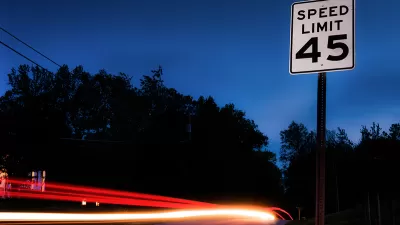
The middle swath of the United States may be considered Red States, but on MetricMaps' new visualization of nationwide speed limits, the states of the Great Plains and Rocky Mountains are a deep blue. It turns out that places that lean libertarian don't much like to place limits on drivers. Today, freedom means a speed limit of 80 MPH in many places, meaning that actual speeds are likely to be much higher.
"The Missouri River, as it turns out, is a kind of speed-limit fault line: Most states west of it consider legal what Virginia, Ohio and Illinois would call 'speeding.'"
MetricMaps has made visualizations of individual cities, displaying road networks according to their speed limits. Large areas of local streets that might be limited to 30 MPH are punctuated by arterial roads and freeways. Neutral as they are, the maps leave it to urban planners to decide how these speeds impact quality of life and safety for pedestrians and drivers alike.
"These maps, through the lens of speed limits, reflect the hierarchy of how we build roads, from local residential streets, to busier boulevards, to limited-access arterials and high-speed highways. Each environment demands different standards. But this national map also raises a question central to"vision zero" campaigns trying to end pedestrian deaths and make roads safer: Does it make sense that a residential neighborhood in Houston would allow faster traffic than a residential neighborhood in Brooklyn?"
Read the full story: Where ‘speeding’ is legal: A map of maximum limits across the U.S.

A Map of Worldwide Speed Limits
Do you have a need for speed? Or at least a need to know the speed limit anywhere in the world? Greater Greater Washington has just the map for you.
Oregon cities are excluding a key tool that could help their housing goals: maps
An effort to use geospatial analysis to understand how housing and access to opportunity are distributed in Oregon cities has largely stalled.

San Antonio could lower speed limit to 25mph
City officials want to lower speed limits and take other steps to reduce speeding and improve traffic safety on neighborhood streets.

Planetizen Federal Action Tracker
A weekly monitor of how Trump’s orders and actions are impacting planners and planning in America.

‘Going backwards:’ Baltimore mayor, students rally against state's transit funding plan
Maryland's proposed six-year plan provides no funding for Baltimore’s BMORE bus program and reduces its road maintenance funding.

Detroit to transform waterfront with $2.2 billion investment
Developers will convert about 18 acres of unused parking lot space into civic spaces.

Newsom vetoes high-speed rail supervision bill after agency receives condemnatory audit
The audit found the CHSRA approved almost $600,000 in unallowable travel expenses.

Nation sees first electric plane-boat hybrid take off in public demo
The Viceroy Seaglider can fly at speeds of 180mph for up to 180 miles.

One of nation’s poorest counties to receive $6 billion data center
The developers estimate the project will create 200 permanent jobs and 1,000 temporary construction jobs.

FREE Course: Walkable City 1: Why Walkability?
After describing his path towards focusing on walkability as the essence of good planning, Jeff Speck marches through his five principal reasons for making more walkable places.
Reinventing Malls: Planning Alchemy—Turning Gray Fields Into Gold
The course focuses on the opportunities and imperatives that shape reinvention of mall sites.

City of Thousand Oaks
City of Wisconsin Rapids
Harvard University Graduate School of Design
The Architects Foundation
University of Cincinnati Online
Northern Illinois Transit Authority (NITA)
The Pocatello Development Authority
The Urban Renewal Agency of the City of Pocatello