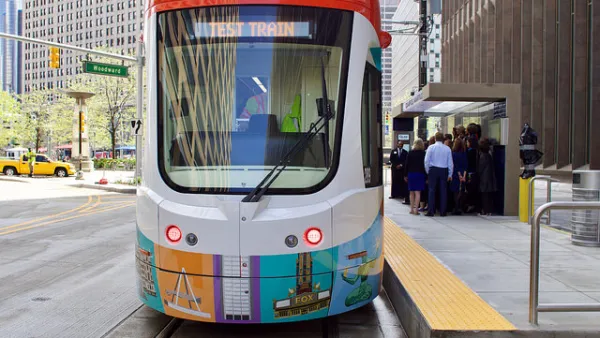
Detroit's M-1 Rail, under construction since 2014, has bumped back its project delivery date. Blame for the delay is assigned to weather, streetcar delivery delays, and the roll out of a federal transportation law from 2012.


"A year after construction began on the M-1 Rail transit line, officials say passenger service should begin in spring 2017 rather than late 2016 as initially predicted with more time needed to work through updated federal safety regulations," reports John Gallagher.
Interestingly, the delay is partly blamed on the roll out of MAP-21, the 2012 law that added new regulations to process of testing and certifying the 3.3-mile streetcar route.
Paul Childs, chief operating officer for M-1 Rail, is quoted in the article: "MAP-21 is now just being implemented throughout the whole transit area….It's going to be a learning experience. We think we have a sense of it, but it's new and it's the government."
FULL STORY: M-1 Rail start-up delayed until early 2017

Detroit Streetcar: Dan Gilbert Dubs Thee 'QLINE'
After purchasing the naming rights of the streetcar line formerly known as M-1 for $5 million, Dan Gilbert made a big reveal Thursday in Detroit.
Op-Ed: Detroit's QLINE Is 'At Times an Embarrassment'
Randy Essex details why it is that "rely" isn't a word that comes to mind for many Detroiters when they think about downtown's QLINE streetcar system.
Lane Closure to Occasionally Make Space for Detroit's QLine Streetcar
Woodward Avenue will get a temporary road diet during special events in response to safety concerns connected to the QLine.

Planetizen Federal Action Tracker
A weekly monitor of how Trump’s orders and actions are impacting planners and planning in America.

The state-sanctioned urbicide of Austin
People don’t kill cities. Freeways do.

US to reduce Colorado River water deliveries to Mexico
A new Colorado Treaty amendment reduces Mexico’s Colorado River water allocation by 250,000 acre feet.

Guerilla urbanists are building DIY bus stop benches in Chicago
A before-and-after of one of the bus stops with a new bench. The new benches are not officially sanctioned or permitted, but the residents who placed them hope they will be the start of a network of DIY benches across the city.

Mamdani overhauls NYC's Vision Zero plan with 100 new policy goals
The overhaul aims to reduce traffic deaths and make streets safer for pedestrians, cyclists and drivers through lower speed limits, new safety infrastructure and more.

Amtrak not solely to blame for New Jersey commuter rail's unreliability, report finds
A new study from the Garden State Initiative found that NJ Transit’s budget grew 20% across a 4 year period, but reliability declined significantly over the same period.

FREE Course: Walkable City 1: Why Walkability?
After describing his path towards focusing on walkability as the essence of good planning, Jeff Speck marches through his five principal reasons for making more walkable places.
Reinventing Malls: Planning Alchemy—Turning Gray Fields Into Gold
The course focuses on the opportunities and imperatives that shape reinvention of mall sites.

Eagle County Government
Harvard University Graduate School of Design
Nashville Planning Department
The Architects Foundation
University of Cincinnati Online
The Pocatello Development Authority
The Urban Renewal Agency of the City of Pocatello
Journal of the American Planning Association