The American Planning Association has released new information on the role of planners in providing safe routes to parks.


The Planning and Community Health Center of the American Planning Association (APA) recently released a fact sheet on Safe Routes to Parks [pdf], "with a particular focus on the role of planners," according to a post by Elizabeth Whitton, AICP.
According to the post, "[t]he planning profession is uniquely positioned to improve the public’s health and well-being through increasing access to parks and open space." Thus, "Safe Routes to Parks is an emerging concept that embraces an interdisciplinary, systems approach that refers to the infrastructure necessary for facilitating access to parks through walking, biking, and transit."
The article also shares a recent webinar facilitated by the APA to discuss strategies for improving access to parks.
Read the full story: Get the Facts on Safe Routes to Parks

‘Quiet Parks’ Highlight Importance of Silence for Public Health
The initiative recognizes parks and other areas that preserve natural quiet in a world full of noise pollution.
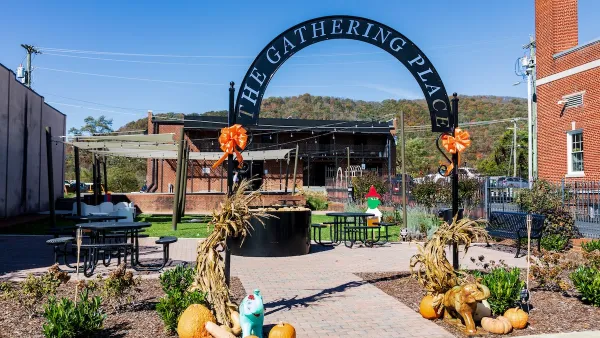
Report: The State of Public Spaces
A 50-year-old institution takes stock of placemaking in the public realm today.

Addressing Tree Canopy Disparity in South Los Angeles
A new study highlights the complex challenge of addressing tree canopy disparities in South L.A., where historical environmental injustices, budget constraints, and competing community priorities hinder efforts to increase equitable tree coverage.

Planetizen Federal Action Tracker
A weekly monitor of how Trump’s orders and actions are impacting planners and planning in America.

Washington state to charge fee to drivers with fuel-efficient cars
Revenue from the fee will go towards supporting the state’s highways.

Illinois considers spending $1 billion in taxpayer money on data center
A quantum computing campus and data center are currently under construction in Chicago.

Senate passes bill overhauling permitting
The bill still needs to pass the House.

Did data centers change how voters cast their ballots?
Texas, Ohio, and Georgia all flipped party control. But in rural counties, the effect of local data centers was mixed.

Amtrak invests in eight new Airo trainsets
The new trainsets will begin serving passengers in 2031.

FREE Course: Walkable City 1: Why Walkability?
After describing his path towards focusing on walkability as the essence of good planning, Jeff Speck marches through his five principal reasons for making more walkable places.
Reinventing Malls: Planning Alchemy—Turning Gray Fields Into Gold
The course focuses on the opportunities and imperatives that shape reinvention of mall sites.

City of Charlotte
City of Rosemead
Rutgers University, Edward J. Bloustein School of Planning and Public Policy
University of Michigan School for Environment and Sustainability (SEAS)
Hunter College, City University of New York (CUNY)
The Architects Foundation
University District Partnership