After a protracted controversy, the United States Olympic Committee officially terminated the bid for Boston to host the 2024 Summer Olympic Games.


"After a tortuous seven-month public process, the United States Olympic Committee on Monday acknowledged that it had failed to win over the people of Boston to host the 2024 Summer Games and it officially pulled the plug on its bid to put forth Boston as America’s host city," reports Katharine Q Seeyle.
Scott Blackmun, the chief executive of the U.S.O.C., explained that the decision resulted from a lack of support from the citizens of Boston.
"The decision followed a bombshell announcement Monday morning by Mayor Martin J. Walsh that he would not sign a host city contract with the U.S.O.C. if it wanted him to do so by the end of the day," adds Seeyle.
The U.S.O.C. also said that it would consider other cities for a 2024 bid. Los Angeles, San Francisco, and Washington, D.C. were the other finalists when the U.S.O.C. selected Boston.
Read the full story: Boston’s Bid for Summer Olympics Is Terminated

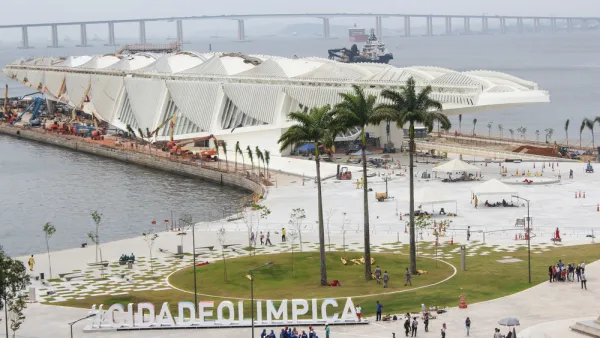
Abandoned Olympic Venues Cast Doubt on the Value of Hosting
Though cities hope for an economic boost, these photos show it's far from guaranteed.
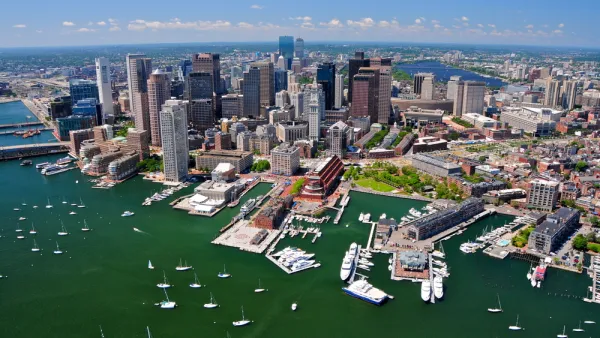
Boston Olympic Plan Includes 8,000 Units of Housing
As it vies to host the 2024 Summer Games, Boston's plan envisions two new permanent neighborhoods built with a mix of public and private investment. The final decision will take place in September.
Can the 2024 Olympics Help Boston Plan for a Better 2124?
Can the Olympic bid provide an impetus for long-range planning for the Boston metropolitan area?

Planetizen Federal Action Tracker
A weekly monitor of how Trump’s orders and actions are impacting planners and planning in America.

Amtrak, CN end decades-long dispute with eight-year agreement
The new operating agreement establishes an updated framework for the companies to work together, including processes to resolve disputes.

Judges permit Denver to divert 77,000 acre feet from the Colorado River for reservoir expansion
Overuse and climate change have caused the Colorado River’s water levels to plummet.

Boston has spent millions making the Green Line more accessible — and there’s no end in sight
While the city has invested millions into expanding and adding platforms to the Green Line to make it more accessible, new train cars set to arrive next year will be too tall for disabled passengers to board without raising the current platforms.

Idaho may see an 18% drop in federal surface transit funding — the largest estimated cut in the US
Transit systems in rural communities are much more reliant on federal funding to provide their services.

How ‘post-disaster gentrification’ alters neighborhoods after natural calamities
After hurricanes, fires or other calamities, the original residents of a community are often replaced by younger, wealthier residents.

FREE Course: Walkable City 1: Why Walkability?
After describing his path towards focusing on walkability as the essence of good planning, Jeff Speck marches through his five principal reasons for making more walkable places.
Reinventing Malls: Planning Alchemy—Turning Gray Fields Into Gold
The course focuses on the opportunities and imperatives that shape reinvention of mall sites.

City of Wisconsin Rapids
Harvard University Graduate School of Design
KFH Group Inc.
The Architects Foundation
University of Cincinnati Online
The Pocatello Development Authority
The Urban Renewal Agency of the City of Pocatello