For a long time, surface parking lots blanketed Maryland's Montgomery County. Developers and county officials now prioritize mixed-use infill with parking concealed underground.


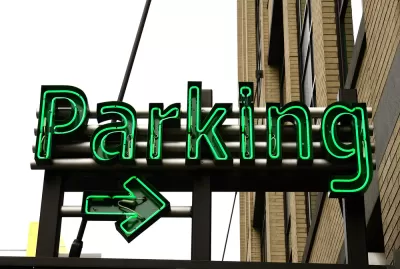
As the affluent area grows more urban, Montgomery County looks forward to a decline in asphalt and concrete. "Many big public lots near shopping districts or public transportation hubs also happen to be on some of the most prime real estate in the county. Developers would rather turn them into something like The Flats at Bethesda, which will have restaurants, stores and upscale condos."
Some longtime parkers experienced separation anxiety. "When we closed the parking ... I didn't realize how many people had a personal reserved parking space in a public lot. So many came up and said 'You took my parking away. You took my space away.' But the end result is what was 300 surface parking spaces is now 960 underground parking spaces and what we hope people will appreciate as beautiful stuff above."
"Surface parking lots are becoming increasingly obsolete, says County Executive Isiah Leggett." Between less surface parking, more bikes, and declining VMT, Montgomery seems set to eventually wean itself off car dependence.
Read the full story: Big Outdoor Parking Lots Look Like Something Else To Montgomery County

Des Moines Plans to Repurpose Downtown Parking Lots
City officials want to encourage the redevelopment of underused surface parking lots.
Houston Awarded $18.5M for Trail Linking Uptown and Memorial Park
The grant will make the freeway-bounded park more accessible to pedestrians and cyclists.

Depave Paradise: Reclaiming Parking Lots for Park Space
The promoters of a new park hope to provide a model for how replacing surface parking lots with green space can mitigate urban heat and boost urban biodiversity.

Planetizen Federal Action Tracker
A weekly monitor of how Trump’s orders and actions are impacting planners and planning in America.

California plans to bury El Niño’s downpour
If the state plays its cards right, it may be able to store a billion acre-feet of El Niño’s water in aquifers.

Desperate measures: Advocates weigh draining Lake Powell to fill Colorado River
Draining the reservoir could reduce evaporation losses by a couple hundred thousand acre-feet.

Chicago voters approve permanent festival grounds, penalty for vacant property owners
Currently, major summer and fall festivals take over public parks for weeks at a time, drawing criticism from nearby residents

NYC votes to cut outdoor dining red tape, speed up permitting
New York City also voted to allow the Department of Transportation to begin work on urgent projects before notifying elected officials.

California appears to reject Prop. 45
The proposition would have expanded the projects that qualify for a streamlined environmental review, effectively paring down the California Environmental Quality Act.

FREE Course: Walkable City 1: Why Walkability?
After describing his path towards focusing on walkability as the essence of good planning, Jeff Speck marches through his five principal reasons for making more walkable places.
Reinventing Malls: Planning Alchemy—Turning Gray Fields Into Gold
The course focuses on the opportunities and imperatives that shape reinvention of mall sites.

City of Rosemead
Rutgers University, Edward J. Bloustein School of Planning and Public Policy
One Hundred Miles
Hunter College, City University of New York (CUNY)
The Architects Foundation
University of Cincinnati Online
City of Cambridge
Montrose County
The Pocatello Development Authority