Pope Francis, sticking to his job description, is out to save the world and all its creatures. Maybe we can help in our own little universes, where we can influence planning and design that makes for swell places and for reduced contributions to GHG.


"Even before last week’s official release of Pope Francis’s encyclical on climate change, advocates and defenders were honing their talking points. The pontiff promotes the potential of a 'communitarian salvation' that 'generates creative ideas for the improvement of a building or a neighbourhood.' And he reminds us of the interconnections between the built and natural environments, between all living things. He calls it 'an integral ecology, one which clearly respects its human and social dimensions.'”
Ben Brown goes on to review the encyclical from a city planning perspective, and ties it into several other urbanism reports and concludes:
"Movement to urbanized areas that offer more choices for living, working, playing and getting around without a car is driven by economic and demographic trends that seem irreversible. And whether people migrating to such places are motivated by reducing their carbon footprint or not, that’s the bonus they, their community and the global effort to reduce greenhouse gas emissions get from their decisions."
Read the full story: Pope Goes Global: Let’s talk local
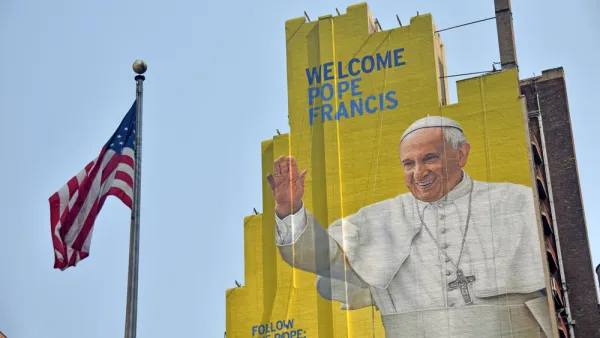
In the U.S., Climate Politics Trump the Pope's Message
The encyclical "Laudato si: On the Care of Our Common Home" might have scored public relations points among environmentalists last year, but according to a new study, it didn't score any points with Catholics or the broader U.S. population.
No Papal Blessing for Cap-And-Trade
Governments must take correction actions to address climate change, warned Pope Francis in his June 18 encyclical, but cap-and-trade, which places a price on carbon emissions but can lead to speculation, is not one of them.
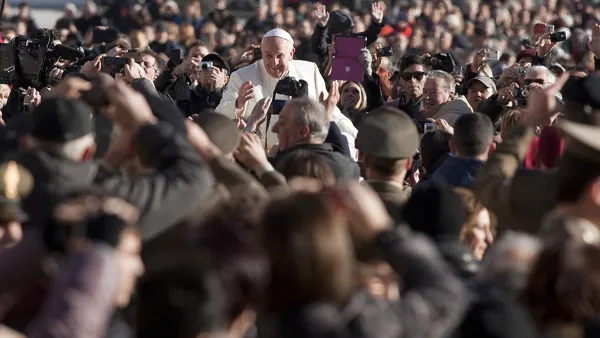
Pope Francis Taps Planners to Help Solve Climate Change
Pope Francis's unprecedented focus on climate change and the environment includes strong messages for planners and designers of the built environment.

Planetizen Federal Action Tracker
A weekly monitor of how Trump’s orders and actions are impacting planners and planning in America.

Washington state to charge fee to drivers with fuel-efficient cars
Revenue from the fee will go towards supporting the state’s highways.

Illinois considers spending $1 billion in taxpayer money on data center
A quantum computing campus and data center are currently under construction in Chicago.

Did data centers change how voters cast their ballots?
Texas, Ohio, and Georgia all flipped party control. But in rural counties, the effect of local data centers was mixed.

Amtrak invests in eight new Airo trainsets
The new trainsets will begin serving passengers in 2031.

HUD to end aid for mixed-immigration-status households
The new rule is projected to impact 80,000 people, nearly half of whom are children.

FREE Course: Walkable City 1: Why Walkability?
After describing his path towards focusing on walkability as the essence of good planning, Jeff Speck marches through his five principal reasons for making more walkable places.
Reinventing Malls: Planning Alchemy—Turning Gray Fields Into Gold
The course focuses on the opportunities and imperatives that shape reinvention of mall sites.

City of Charlotte
City of Rosemead
Rutgers University, Edward J. Bloustein School of Planning and Public Policy
University of Michigan School for Environment and Sustainability (SEAS)
Hunter College, City University of New York (CUNY)
The Architects Foundation
University District Partnership