An annual competition to recognize public spaces for their economic and social benefit has announced six finalists.


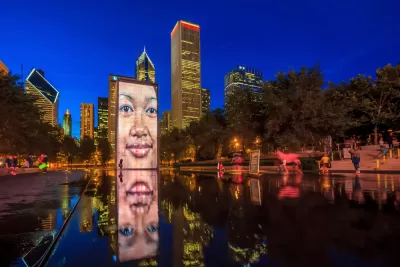
"Selected from entries representing urban areas all over the world, six parks were named finalists in the Urban Open Space Award competition, the Urban Land Institute's (ULI) annual contest to recognize successful large- and small-scale public spaces that have socially and economically enriched their surrounding communities," according to a post by Caroline Massie.
"This year’s six shortlisted projects are the Marina Bay in Singapore; Millennium Park in Chicago; Myriad Gardens in Oklahoma City, Okla.; Thousand Lantern Lake Park System in Foshan, Guangdong, China; Tongva Park and Ken Genser Square in Santa Monica, Calif.; and Washington Canal Park in Washington, D.C."
To be eligible for the competition, the public space must have been open to the public between one and 15 years and be predominantly outdoors, in addition to a host of other qualifications. The article includes photos of each of the six finalists and information on the final award.
Read the full story: Urban Land Institute Shortlists Six International Parks in 2015 Urban Open Space Award Competition

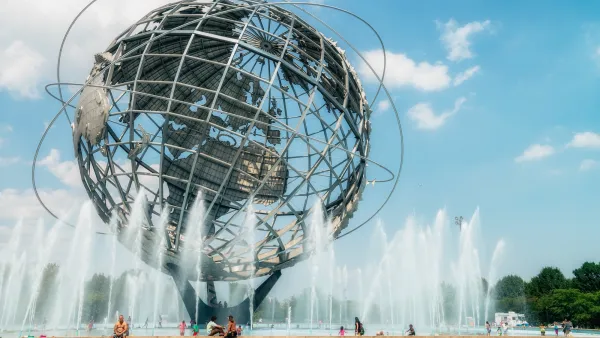
Historic Queens park is getting a $120M upgrade
The borough's largest park will undergo significant upgrades for accessibility, flood mitigation and historic preservation.
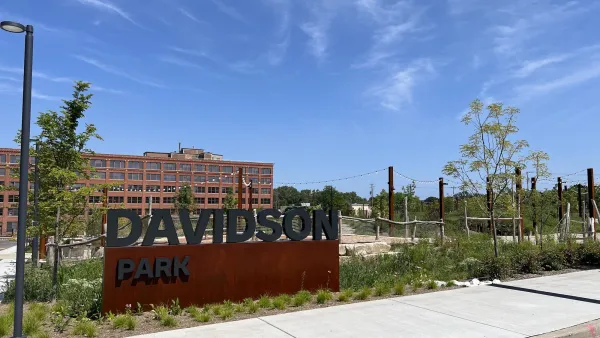
Harley-Davidson turned a Milwaukee parking lot into a green oasis
The park, adjacent to Harley-Davidson headquarters, doubles as stormwater retention infrastructure.
Planning for Love, Part 3: Enhancing human connection through walkability
In the third and final installment of this series, author Hannah Kosoff examines what her research findings say about modern dating and urban form.

Planetizen Federal Action Tracker
A weekly monitor of how Trump’s orders and actions are impacting planners and planning in America.

California plans to bury El Niño’s downpour
If the state plays its cards right, it may be able to store a billion acre-feet of El Niño’s water in aquifers.

Chicago breaks ground on $3 billion megadevelopment
The new neighborhood, titled Foundry Park, will one day host 3,700 residences.

Satanic place names
From streams and lakes to valleys and canyons, I mapped more than 1,000 places named after the Devil.

California High-Speed Rail Authority CEO resigns after $600,000 scandal
Under Ian Choudri, the authority used taxpayer dollars to fund first class flights and trips to nightclubs.

Want to study the Missouri River? Soon, you may need unanimous approval from 10 states
Legislation would require 10 governors’ permission to study or build projects moving water outside the basin.

FREE Course: Walkable City 1: Why Walkability?
After describing his path towards focusing on walkability as the essence of good planning, Jeff Speck marches through his five principal reasons for making more walkable places.
Reinventing Malls: Planning Alchemy—Turning Gray Fields Into Gold
The course focuses on the opportunities and imperatives that shape reinvention of mall sites.

City of Rosemead
Rutgers University, Edward J. Bloustein School of Planning and Public Policy
One Hundred Miles
Hunter College, City University of New York (CUNY)
The Architects Foundation
University of Cincinnati Online
City of Cambridge
Montrose County
The Pocatello Development Authority