San Francisco recently hosted a series of events to make the city's backbone, Market Street, a little more fun. It's the latest of many efforts to revitalize a street that has been problematic even as the rest of the city has boomed.


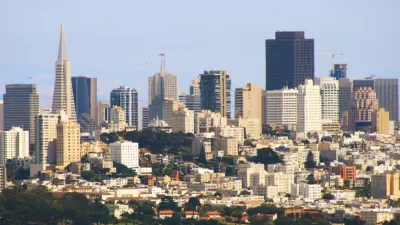
For the most part, San Francisco's Market Street is no fun. The section in the Financial District is all business, with commuters scurrying into and out of office buildings at all hours of the day. Further up, the mid-Market stretch through the notorious Tenderloin District has been a pocket of blight in one of the nation's most gentrified cities. The city has a $500 million plan to redesign and revitalize the street by 2018.
In the meantime, the Market Street Prototyping Festival, held in early April, is an attempt to inject some fun into the plans for the new Market Street. The festival featured 50 tactical urbanist projects intended to bring fun and neighborholiness to the urban environment. Projects included six-way table tennis, chalk art, combinations of dance and video art, and odd versions of karaoke. The San Francisco planning department's City Design Group, in collaboration with Ghel Studio, is part of the team that will evaluate the 50 prototypes and choose finalists for permanent installation.
“There are old and new residents vying for space in the city, and so we, as city planners, have to find a way to start bringing these sides together. We feel our public spaces have to be those places where people from different backgrounds come together and start to build some empathy," Neil Hrushowy, manager of the City Design Group, told Next City.
Read the full story: Will S.F.’s Market Street Be Redesigned Into a Place for Play?
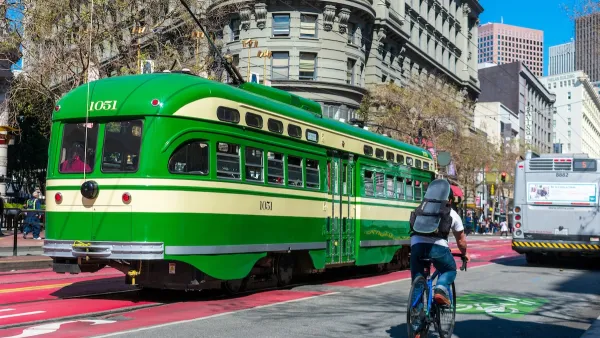
SF’s Market Street Will no Longer be Car-free
The city will allow Waymo robotaxis and ride-hailing app vehicles to drive down the car-free stretch of Market Street as part of Mayor Dan Lurie’s effort to help revitalize local businesses.
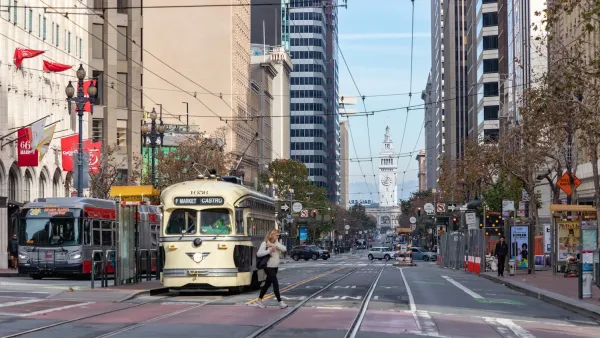
Waymo Gets Permission to Map SF’s Market Street
If allowed to operate on the traffic-restricted street, Waymo’s autonomous taxis would have a leg up over ride-hailing competitors — and counter the city’s efforts to grow bike and pedestrian on the thoroughfare.
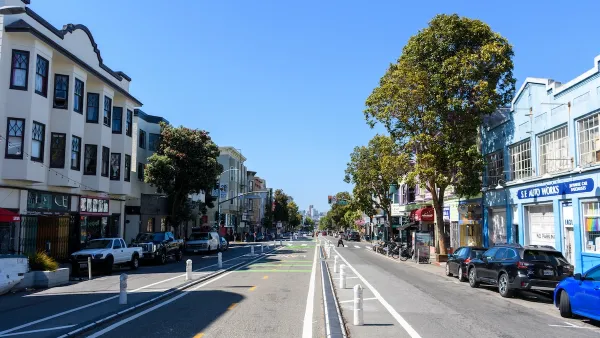
How San Francisco’s ‘People Protected Bike Lanes’ are Moving the Needle on Road Safety
A local bike safety protest has become a global phenomenon.

Planetizen Federal Action Tracker
A weekly monitor of how Trump’s orders and actions are impacting planners and planning in America.

Eastern Nebraska is running out of electricity
Data centers and electrification are straining eastern Nebraska’s grid, throttling economic development.

Washington state to charge fee to drivers with fuel-efficient cars
Revenue from the fee will go towards supporting the state’s highways.

Instead of building new housing, LA developers are turning mansions into mega-mansions
In the richest areas, the number of houses valued at $30 million with demolition permits has skyrocketed since 2018.

Illinois considers spending $1 billion in taxpayer money on data center
A quantum computing campus and data center are currently under construction in Chicago.

As development costs rise, Boston moves to lessen affordable housing requirements
The Boston Zoning Commission and the City Council still need to approve Boston Mayor Michelle Wu’s proposed changes

FREE Course: Walkable City 1: Why Walkability?
After describing his path towards focusing on walkability as the essence of good planning, Jeff Speck marches through his five principal reasons for making more walkable places.
Reinventing Malls: Planning Alchemy—Turning Gray Fields Into Gold
The course focuses on the opportunities and imperatives that shape reinvention of mall sites.

City of Charlotte
City of Rosemead
Rutgers University, Edward J. Bloustein School of Planning and Public Policy
University of Michigan School for Environment and Sustainability (SEAS)
Hunter College, City University of New York (CUNY)
The Architects Foundation
City of Cambridge
The Pocatello Development Authority
The Urban Renewal Agency of the City of Pocatello