A recently published book describes the outcomes of the EcoMobility festival held in Suwon, South Korea during September of 2013.



Teresa Deckert reviews a book called Neighborhood in Motion One Neighborhood, One Month, No Cars, by Konrad Otto-Zimmermann and Yeonhee Park. The book, as the title suggests, "shows how a one-month car-free festival in a neighborhood affects the urban spaces and the mindsets and lifestyles of the residents."
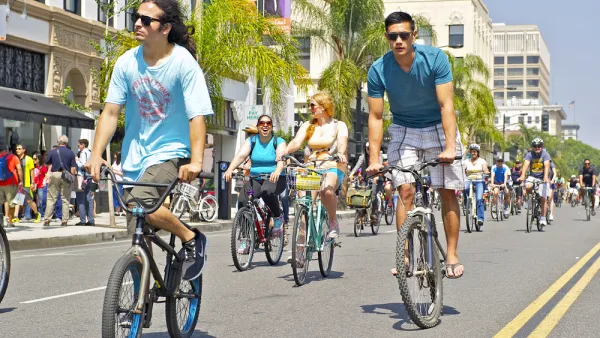
The one-month experiment was held during the September 2013 EcoMobility Festival in the neighborhood of Haenggung-dong in the South Korean city of Suwon. During the festival, according to Deckert, "1,500 registered cars were blocked from the neighborhood for 30 days." Moreover, "The district’s 4,300 residents were forced to switch over to alternative modes of transport, or ‘EcoMobility’ — walking, cycling, ‘wheeling’, public transport and car-sharing."
According to Deckert, the book provides insight into how festival organizers pulled off the car-free month as well as illustrations and descriptions of how the neighborhood changed as a result of the experiment.
Read the full story: Neighborhood In Motion: One Neighborhood, One Month, No Cars

First Open Streets Event Coming to D.C.
The nation's capital could soon join the 122 U.S. municipalities with open streets events.
10 of the Most Beloved Open Streets Events
Mike Lydon shares ten of his favorite open streets events with USA Today.

Paris Voters Approve More Car-Free Streets
Paris Mayor Anne Hidalgo says the city will develop a plan to close 500 streets to car traffic and add new bike and pedestrian infrastructure after a referendum on the proposal passed with 66 percent of the vote.

Planetizen Federal Action Tracker
A weekly monitor of how Trump’s orders and actions are impacting planners and planning in America.

Amtrak, CN end decades-long dispute with eight-year agreement
The new operating agreement establishes an updated framework for the companies to work together, including processes to resolve disputes.

Judges permit Denver to divert 77,000 acre feet from the Colorado River for reservoir expansion
Overuse and climate change have caused the Colorado River’s water levels to plummet.

Philadelphia to invest $2 billion into upgrading city airports as PHL places last in customer satisfaction
Modernizations to Philadelphia's airports will include baggage system upgrades and a new automated parking garage guidance system.

The LA housing policies making developers turn away from the city
Despite LA’s housing shortage, developers say the city’s "mansion-tax" and pandemic-era policies make it an unappealing place to build housing.

New density bill would require 7 California cities to establish regional transit hubs
The bill would also require major cities in California to permit high-rise residential buildings.

FREE Course: Walkable City 1: Why Walkability?
After describing his path towards focusing on walkability as the essence of good planning, Jeff Speck marches through his five principal reasons for making more walkable places.
Reinventing Malls: Planning Alchemy—Turning Gray Fields Into Gold
The course focuses on the opportunities and imperatives that shape reinvention of mall sites.

City of Wisconsin Rapids
Harvard University Graduate School of Design
KFH Group Inc.
The Architects Foundation
University of Cincinnati Online
The Pocatello Development Authority
The Urban Renewal Agency of the City of Pocatello