In a district now comprised entirely of charter schools, many New Orleans children face hour-plus journeys. This makes for increased stress on low-income families and a potential rise in chronic absenteeism.


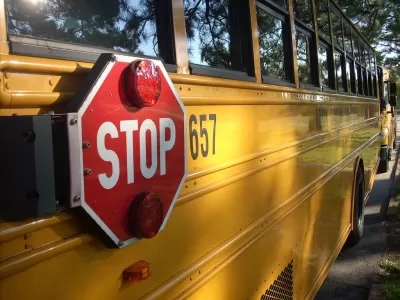
Kyle Berlin reports on a troubling phenomenon: New Orleans kids are finding it difficult to physically get to school. An experimental policy shift may be to blame: "Last year, New Orleans became home to the first school district in the nation made up entirely of charter schools. The effects of this transformation have been dramatic, complex, and heavily debated, but one of the more straightforward consequences is that kids simply travel much farther than they once did to get to school."
Longer journeys increase the chances a child won't make it to school at all: "[...] chronic absenteeism, defined as missing 10 percent or more of school each year. The chronic absenteeism rate among students from pre-kindergarten to fourth grade in New Orleans is 16.2 percent."
Parent Renata Jones recounts schools knit tighter with the community, both in terms of distance and involvement. "Back then, Habans [a local public elementary school] 'was totally different,' Jones says. 'The parents were more involved. The teachers were more involved.' It was a solid school that was close to home. Jones, who grew up in the same house where she lives now, walked there in the mornings with her grandfather."
Read the full story: Uphill Both Ways

Cincinnati School District Shifts Students to Public Transit to Cut Costs
Over 10,000 Cincinnati Public Schools students already use public buses for school transportation each year.

Parents Turn to Ride-Hailing as Schools Pull Bus Transportation
Some districts are cutting back on school buses, leaving some children without reliable transportation to and from school.

School Drop-Off Traffic Is Causing a Congestion — and Social — Crisis
School drop-off lines are becoming longer and more isolating than ever.

Planetizen Federal Action Tracker
A weekly monitor of how Trump’s orders and actions are impacting planners and planning in America.

California plans to bury El Niño’s downpour
If the state plays its cards right, it may be able to store a billion acre-feet of El Niño’s water in aquifers.

Chicago breaks ground on $3 billion megadevelopment
The new neighborhood, titled Foundry Park, will one day host 3,700 residences.

California High-Speed Rail Authority CEO resigns after $600,000 scandal
Under Ian Choudri, the authority used taxpayer dollars to fund first class flights and trips to nightclubs.

Want to study the Missouri River? Soon, you may need unanimous approval from 10 states
Legislation would require 10 governors’ permission to study or build projects moving water outside the basin.

Desperate measures: Advocates weigh draining Lake Powell to fill Colorado River
Draining the reservoir could reduce evaporation losses by a couple hundred thousand acre-feet.

FREE Course: Walkable City 1: Why Walkability?
After describing his path towards focusing on walkability as the essence of good planning, Jeff Speck marches through his five principal reasons for making more walkable places.
Reinventing Malls: Planning Alchemy—Turning Gray Fields Into Gold
The course focuses on the opportunities and imperatives that shape reinvention of mall sites.

City of Rosemead
Rutgers University, Edward J. Bloustein School of Planning and Public Policy
One Hundred Miles
Hunter College, City University of New York (CUNY)
The Architects Foundation
University of Cincinnati Online
City of Cambridge
Montrose County
The Pocatello Development Authority