Houston isn't freezing over. But, after decades of unbridled, un-zoned development, a new mayor, new planning director, and a raft of civic activists are promoting a general plan for the famously laissez-faire city.



(Updated: 03/24/2015) Houston's lack of zoning has always presented a paradox. On the one hand, it's a conservative policy, giving private enterprise a free hand to build the city, and profit from it, as it sees fit. On the other hand, it has been a radical experiment in city-building, being the only major city in the United States without strict land-use controls.
For over ten years, a nonprofit group called Blueprint Houston has claimed that the experiment has been, if not a failure, then at least problematic. Led by planner Peter Park, Blueprint Houston has led the movement to consider smarter ways for Houston to cope with its explosive growth and perhaps rein in some of the sprawl that has resulted from rampant speculation and leapfrog development: "for Houston, the relationship between development and transportation needs to be addressed—not just cars and future traffic, but also the relationships between development and various types of transportation beyond the automobile."
With the appointment of *Planning and Development Department Director Pat Walsh last year, many of Blueprint Houston's goals are being realized. Upon taking the position, Walsh ordered that a general plan be drafted within a mere 10 months. Walsh touts the plan as a guiding document for operating the city. He emphasizes that zoning ordinances will not immediately spring up like bluebonnets. But, he also contends that Houston isn't exactly un-planned in the first place:
"We regulate development with subdivisions, landscape ordinances, dedication of right of way, drainage, and parking," Walsh told The Architect's Newspaper. "We do have a lot of deed restriction–like zoning protections. We do not expect zoning to be an outcome of this. This is about making sure we are effective as possible at creating and enhancing the city.”
The plan is expected to be presented to the City Council for adoption by this fall.
*The post has been corrected to reflect the proper title and gender for Pat Walsh.
Read the full story: Houston, We Have a Plan


How Houston Can Be a Model for Housing Reform
The city builds more new housing than almost any other and has dramatically reduced homelessness, yet low-income families struggle to find affordable housing.
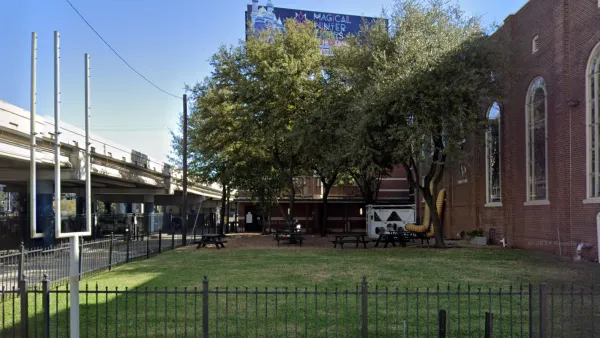
Houston Supportive Housing Development Sparks Debate
Critics say a proposed apartment building would negatively impact the neighborhood’s walkability.

How Houston Keeps Housing Affordable
The city’s limited land use regulations have kept housing costs relatively low, but government intervention is still needed to provide housing to the lowest-income residents.

Planetizen Federal Action Tracker
A weekly monitor of how Trump’s orders and actions are impacting planners and planning in America.

California plans to bury El Niño’s downpour
If the state plays its cards right, it may be able to store a billion acre-feet of El Niño’s water in aquifers.

Desperate measures: Advocates weigh draining Lake Powell to fill Colorado River
Draining the reservoir could reduce evaporation losses by a couple hundred thousand acre-feet.

Chicago Avenue bridge construction delays enrages city leaders
The bridge has been closed since 2025. The city originally aimed to re-open it in December, and now expects to finish construction in 2027.

NYC bus network redesign speeds up Queens buses
Rush routes have seen a 4.6% speed increase after the redesign.

California High-Speed Rail Authority picks trainset manufacturer
The California High-Speed Rail Authority aims to start servicing passengers by 2033.

FREE Course: Walkable City 1: Why Walkability?
After describing his path towards focusing on walkability as the essence of good planning, Jeff Speck marches through his five principal reasons for making more walkable places.
Reinventing Malls: Planning Alchemy—Turning Gray Fields Into Gold
The course focuses on the opportunities and imperatives that shape reinvention of mall sites.

City of Rosemead
Rutgers University, Edward J. Bloustein School of Planning and Public Policy
One Hundred Miles
Hunter College, City University of New York (CUNY)
The Architects Foundation
University of Cincinnati Online
City of Cambridge
Montrose County
The Pocatello Development Authority