An exhibit at LA’s Annenberg Space for Photography looks at how different communities are adapting in order to become resilient to the threats of climate change - a review by LA County planner Clement Lau.


For those who have moved past the "if" and on to the "how" to deal with climate change, an exhibit at the Annenberg Space for Photography in Los Angeles is an eye opener.
"Sink or Swim: Designing for Sea Change" is a photography exhibit that features the work of Iwan Baan, Jones Bendiksen, Paula Bronstein, and Stephen Wilkes, looking at how infrastructure planning has been used to offer some sort of resilience in the face of climate change. Los Angeles County planner Clement Lau writes a review.
"The images selected for the exhibit explore the issue of building for resilience in the face of climate change and sea level rise in particular. The photographs capture efforts to adapt for survival as well as ambitious infrastructure planning in a variety of coastal communities, ranging from the Kurigram District in Bangladesh to the Lower Ninth Ward in New Orleans to the Netherlands."
Lau writes about some of the key projects captured in those photos, which include floating schools in Bangladesh, a landmark roller coaster in New Jersey partly submerged in the Atlantic Ocean during Hurricane Sandy, and a boulevard in the Netherlands aligned with a 12-meter high sea wall concealed with undulating dune and stepped-back levels that key cars, bikes, and pedestrians separated.
Read the full story: Exhibit Review: Sink or Swim – climate change resilience in photographs at Los Angeles’s Annenberg

California State Law Calls on Coastal Regions to Create Resiliency Plans
Cities and counties at risk of flooding and erosion from sea level rise can access state funding to implement coastal resiliency plans.
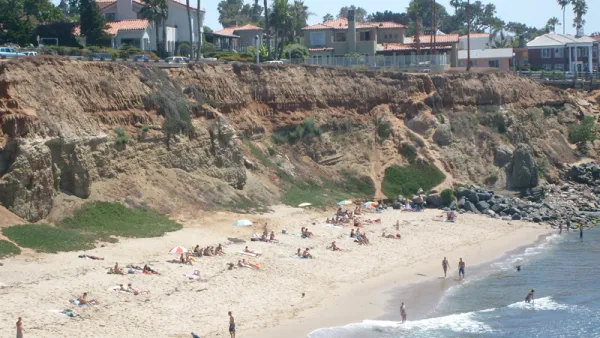
Coastal City Rejects 'Managed Retreat' Strategy
Del Mar, in Southern California, says it does not want to adopt the approach as part of its sea-level rise adaptation plan.
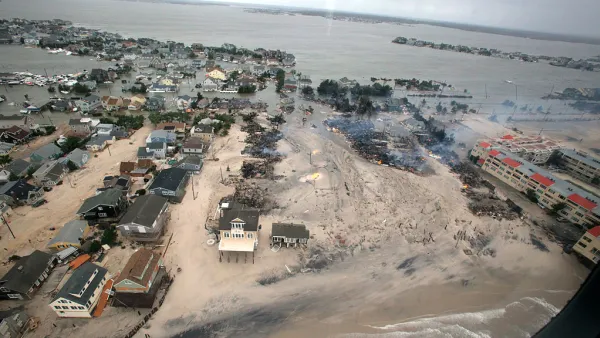
How Sea Level Rise Will Change the Country's Geography
In a worst case scenario, generated by a new study published in the Proceedings of the National Academy of Sciences of the United States of America, land home to 25 million Americans will be lost to rising seas as a result of climate change.

Planetizen Federal Action Tracker
A weekly monitor of how Trump’s orders and actions are impacting planners and planning in America.

Eastern Nebraska is running out of electricity
Data centers and electrification are straining eastern Nebraska’s grid, throttling economic development.

Study reveals best places in the U.S. for cycling, walking
New research from Streetlight Data examines bicycle and pedestrian miles per capita in the 100 largest U.S. cities by population.

DSA members accuse Mamdani of 'abandoning values' over housing redevelopment
New York City's mayor plans to replace about 2,000 units of public housing with private, mixed-income housing.

All sides of BRT debate unhappy with CDOT’s most recent move
The Colorado Department of Transportation is no longer considering center-running bus lanes for Colorado Boulevard.

Massachusetts bogs generate both power, and cranberries
Putting solar panels above farmland is one way Massachusetts is advancing toward its goal of net-zero carbon emissions by 2050.

FREE Course: Walkable City 1: Why Walkability?
After describing his path towards focusing on walkability as the essence of good planning, Jeff Speck marches through his five principal reasons for making more walkable places.
Reinventing Malls: Planning Alchemy—Turning Gray Fields Into Gold
The course focuses on the opportunities and imperatives that shape reinvention of mall sites.

City of Rosemead
Rutgers University, Edward J. Bloustein School of Planning and Public Policy
One Hundred Miles
University of Michigan School for Environment and Sustainability (SEAS)
Hunter College, City University of New York (CUNY)
The Architects Foundation
City of Cambridge
The Pocatello Development Authority
The Urban Renewal Agency of the City of Pocatello