Mapping the nation's 600,000 bridges reveals a remarkably fine-grained map of…the nation.


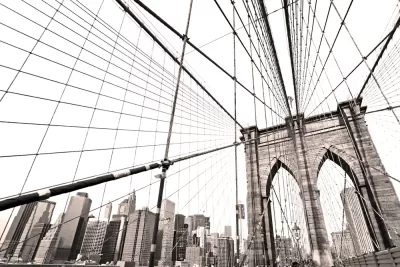
"In his 2016 budget, President Obama proposed a one-time tax on foreign earnings in order to fund a $478 billion program to upgrade the nation's roads, bridges, railroads and more. As policymakers debate the merits of the proposal in coming months, it helps to visualize what exactly we're talking about when we talk about the nation's infrastructure," writes Christopher Ingraham.
To create a resource to aid in that visualization, Wonkblog used data from the Federal Highway Administration's National Bridge Inventory and mapped every bridge in the United States longer than 20 feet.
Ingraham adds more language helpful in setting a political context for the mapping exercise: "The map illustrates the ubiquity of America's [sic] bridges -- it's basically impossible to go for a drive in any densely-populated area and not cross one. But each of those bridges -- all 600,000 of them -- need to be maintained. This maintenance costs money. And some states and localities do a better job of it than others."
Read the full story: A surprisingly accurate map of the U.S. made with 600,000 bridges — and nothing else
Oregon cities are excluding a key tool that could help their housing goals: maps
An effort to use geospatial analysis to understand how housing and access to opportunity are distributed in Oregon cities has largely stalled.
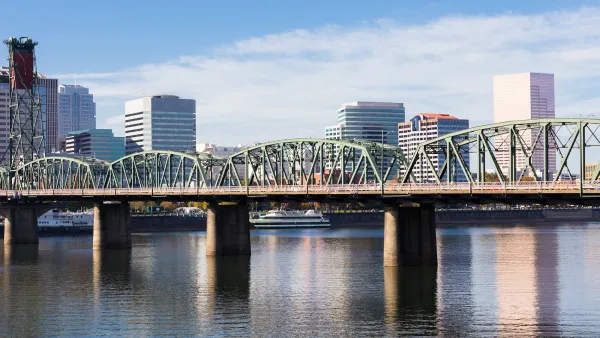
Federal agencies give go-ahead to I-5 Columbia River bridge project
The next few months will clarify whether the massive bridge replacement project will secure the funding to move forward as planned.

Now you can cross from Iowa to South Dakota on a pedestrian bridge
The Big Sioux Pedestrian Bridge connects a park and a golf course on the other side of the Big Sioux River.

Planetizen Federal Action Tracker
A weekly monitor of how Trump’s orders and actions are impacting planners and planning in America.

Washington state to charge fee to drivers with fuel-efficient cars
Revenue from the fee will go towards supporting the state’s highways.

Illinois considers spending $1 billion in taxpayer money on data center
A quantum computing campus and data center are currently under construction in Chicago.

25 states cast bids to be the home of U.S. Space Academy
The academy will train scientists, officers and astronauts for the U.S. Space Force.

Trump’s emergency orders to resuscitate coal plants cost ratepayers $593 million
Keeping coal plants on life support in Florida has cost ratepayers there $25.6 million.

Corpus Christi drilled wells at 'lightning speed,' leaving neighbors fearing for their water supply
Underground water became a critical fix through the worst of Corpus Christi’s drought. But experts warn against depending on wells for too long.

FREE Course: Walkable City 1: Why Walkability?
After describing his path towards focusing on walkability as the essence of good planning, Jeff Speck marches through his five principal reasons for making more walkable places.
Reinventing Malls: Planning Alchemy—Turning Gray Fields Into Gold
The course focuses on the opportunities and imperatives that shape reinvention of mall sites.

City of Charlotte
City of Rosemead
Rutgers University, Edward J. Bloustein School of Planning and Public Policy
University of Michigan School for Environment and Sustainability (SEAS)
Hunter College, City University of New York (CUNY)
The Architects Foundation
University District Partnership