New apps have the potential to influence a fundamental shift in the political and physical realities of parking according to a recent Next City article.


According to Rachel Dovey, "while certain home- and ride-shares spent 2014 making billions and trending so high on the SEO-meter that the term 'Uber Fatigue' now exists, one area that seems built for this capitalistic repurposing is still surprisingly under-hyped: parking."
Describing parking lots in both commercial and residential settings as the very definition of underutilized space, Dovey surveys the companies looking to make an Uber- or Airbnb-like disruption of the status quo of parking. For instance, "Baltimore-based Parking Panda, recently made headlines for its partnership with Amtrak. Through an app, the company allows drivers to reserve parking in advance, contracting with both large garages and individuals — like those shown in TransForm’s research — with an empty space or driveway. It takes 20 percent of each transaction."
Importantly, Dovey notes how these apps could provide inspire home and business owners to think about parking—and its scarcity—differently.
Read the full story: Airbnb-ifying Asphalt Could Shift Parking Politics
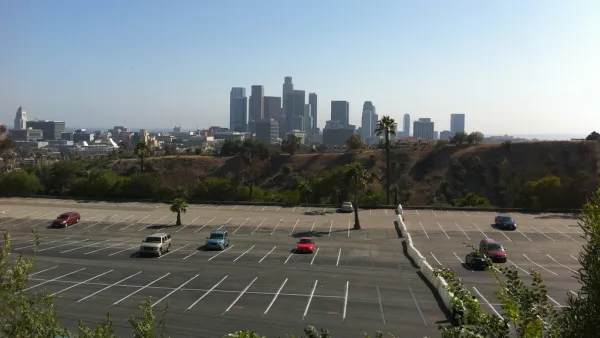
Every Parking Lot, Visualized
A car spends 95 percent of the time parked, and only 5 percent of its time in use. The huge amount of space that system requires is made "intuitively and accessibly" comparable by the What the Street project.
New App Rents Driveway Parking Spaces for $1 an Hour
A pair of entrepreneurs has launched an app that allows property owners to rent driveway spaces to people looking for parking. Also, the app helps people find the parking they are looking for.

How Driverless Cars Could Affect Suburban Land Use
Successful driverless cars might lead to "mini mass transit," a distinct mode from public transit and the private automobile. The consequences for land use could reshape suburbia.

Planetizen Federal Action Tracker
A weekly monitor of how Trump’s orders and actions are impacting planners and planning in America.

California plans to bury El Niño’s downpour
If the state plays its cards right, it may be able to store a billion acre-feet of El Niño’s water in aquifers.

Desperate measures: Advocates weigh draining Lake Powell to fill Colorado River
Draining the reservoir could reduce evaporation losses by a couple hundred thousand acre-feet.

Seattle passes record-breaking transit services expansion
Proposition 1 will double the city’s transit tax to add 95,000 more bus trips and preserve 180,000 bus trips annually.

Post election, Texas is no longer Musk’s 'AI oasis'
Elon Musk dolled out $446 million on the 2026 midterms, the most ever spent by a non-canidate.

Chicago voters approve permanent festival grounds, penalty for vacant property owners
Currently, major summer and fall festivals take over public parks for weeks at a time, drawing criticism from nearby residents

FREE Course: Walkable City 1: Why Walkability?
After describing his path towards focusing on walkability as the essence of good planning, Jeff Speck marches through his five principal reasons for making more walkable places.
Reinventing Malls: Planning Alchemy—Turning Gray Fields Into Gold
The course focuses on the opportunities and imperatives that shape reinvention of mall sites.

City of Rosemead
Rutgers University, Edward J. Bloustein School of Planning and Public Policy
One Hundred Miles
Hunter College, City University of New York (CUNY)
The Architects Foundation
University of Cincinnati Online
City of Cambridge
Montrose County
The Pocatello Development Authority