Environmentalists and developers are in a race against time to prevent a proposed oil-by-rail facility in Vancouver, Washington.


According to Kirk Johnson, "here in southern Washington, some environmental groups are quietly pushing a builder to move even faster with a $1.3 billion real estate project along the Columbia River that includes office buildings, shops and towers with 3,300 apartments."
The strange bedfellows of environmentalists and development interests have teamed up because "[two] miles west of the 32-acre project, called the Waterfront, one of the biggest proposed oil terminals in the country is going through an environmental review, with plans to transfer North Dakota crude from rail cars to barges."
"The result is a sort of race to the crossing: If the Waterfront can get its bricks and mortar in the ground before the terminal is approved — possibly late next year, with litigation likely to follow — more people would be living and working near the oil-train line. Compounding what opponents, led by the city, say are the dangers of spills or derailments, would make the terminal’s path to approval steeper."
The project goes into a lot more detail about the economic case made by each side as well as development proposals for both The Waterfront and the oil terminal.
Read the full story: Race to Build on River Could Block Pacific Oil Route
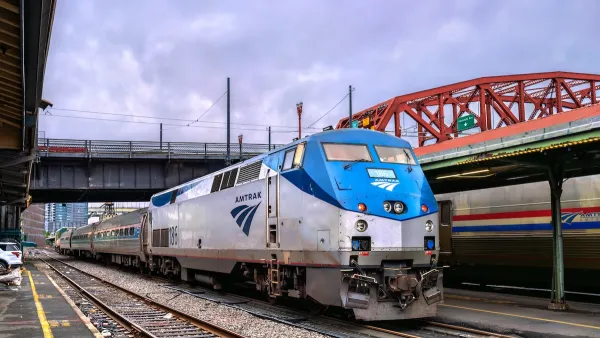
Massive Oil-By-Rail Facility Proposed for Port of Vancouver
A proposed oil-by-rail facility proposed for the Port of Vancouver could set a new standard for capacity.
Will Vancouver Lose It's Farming Mojo?
Vancouver has the most farmland and farmers in North America. However, as Vancouver booms, the thriving agricultural belt that surrounds Greater Vancouver is at risk from an expanding city.
Transit leaders progress high-speed rail from Portland to Vancouver, B.C.
Washington state officials may reveal feasible routes for the high-speed rail in late 2027.

Planetizen Federal Action Tracker
A weekly monitor of how Trump’s orders and actions are impacting planners and planning in America.

Washington state to charge fee to drivers with fuel-efficient cars
Revenue from the fee will go towards supporting the state’s highways.

Illinois considers spending $1 billion in taxpayer money on data center
A quantum computing campus and data center are currently under construction in Chicago.

People Mover delayed again, LAX and contractor trade barbs
The automated train was last slated to open in January 2027.

Trump to blast ‘hydrocarbon highway’ through ‘world’s longest art gallery’
Environmental and historic preservation groups are suing to stop the project.

25 states cast bids to be the home of U.S. Space Academy
The academy will train scientists, officers and astronauts for the U.S. Space Force.

FREE Course: Walkable City 1: Why Walkability?
After describing his path towards focusing on walkability as the essence of good planning, Jeff Speck marches through his five principal reasons for making more walkable places.
Reinventing Malls: Planning Alchemy—Turning Gray Fields Into Gold
The course focuses on the opportunities and imperatives that shape reinvention of mall sites.

City of Charlotte
City of Rosemead
Rutgers University, Edward J. Bloustein School of Planning and Public Policy
University of Michigan School for Environment and Sustainability (SEAS)
Hunter College, City University of New York (CUNY)
The Architects Foundation
University District Partnership