A revised proposal for the "Portland Street Fund," announced this week by the city's political leadership, aims to balance the needs of advocates of alternative transportation and that of the city's business community.


According to John Maus, Portland officials announced the "Portland Street Fund," which would "raise $46 million for maintenance and safety projects through a mix of business fees and personal income taxes."
Portland Mayor Charlie Hales, Transportation Commissioner Steve Novick and PBOT Director Leah Treat announced the street fund, revising an original proposal for a "transportation user fee" back in May of 2014. Mayor Hayes described the current proposal as "More humane and tolerable" as well as "fair, reasonable, and bearable." According to the current proposal, the fee would be charged on the basis of individual income. In another adjustment, the new proposal would attach a fee to business licenses.
Maus also provides the insight and details about how the money generated for the fund will be spent.
Read the full story: City’s new ‘Street Fund’ proposal would raise $46 million a year
Portland to Evaluate Neighborhood Greenway Program
Portland will launch an effort to evaluate and improve its influential neighborhood greenway system of bike friendly residential corridors.
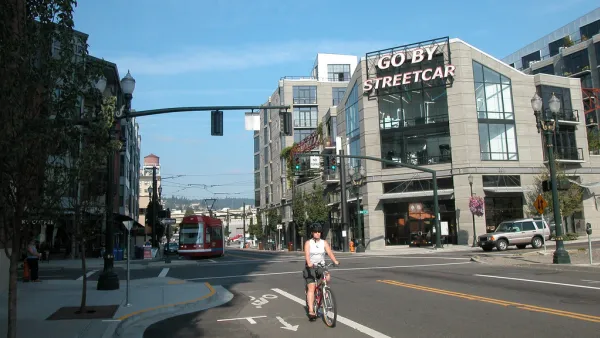
Portland Considering 'Street Fee' for Residents and Businesses
The Portland City Council moved quickly in proposing and revising a "street fee" to finance repairs on the city's crumbling roads. Now a more realistic calendar seems to be in place for considering the fee on residents and businesses.

Portland Anarchists Illegally Repair Potholes
Saying that they believe in direct action and suspecting the motives of the State, a group of Portland anarchists are taking to the streets to fix potholes.

Desperate measures: Advocates weigh draining Lake Powell to fill Colorado River
Draining the reservoir could reduce evaporation losses by a couple hundred thousand acre-feet.

Eastern Nebraska is running out of electricity
Data centers and electrification are straining eastern Nebraska’s grid, throttling economic development.

Move over, LA: St. Louis gears up for Olympics, invests millions in downtown redevelopment
The Missouri city will host the 2028 Olympic soccer group stage and knockout matches.

‘No clear next steps’ for Chicago's permanent festival grounds
Eleventh Ward Ald. Nicole Lee has suggested Soldier Field as a possible location for the permanent event space.

California, Hawaii, Rhode Island approve housing propositions
Hawaii and Rhode Island each approved their sole proposition, while California approved two of its three.

Officials claim feds 'rushed' Amtrak environmental review
Amtrak plans to move their Chicago maintenance facility from an industrial area to a residential one.

FREE Course: Walkable City 1: Why Walkability?
After describing his path towards focusing on walkability as the essence of good planning, Jeff Speck marches through his five principal reasons for making more walkable places.
Reinventing Malls: Planning Alchemy—Turning Gray Fields Into Gold
The course focuses on the opportunities and imperatives that shape reinvention of mall sites.

City of Rosemead
Rutgers University, Edward J. Bloustein School of Planning and Public Policy
One Hundred Miles
University of Michigan School for Environment and Sustainability (SEAS)
Hunter College, City University of New York (CUNY)
The Architects Foundation
City of Cambridge
Montrose County
The Pocatello Development Authority