A new study from Virginia Tech reclassifies what defines multi-modal commuters.


As discussed on CityLab by Eric Jaffe, a new study by Virginia Tech scholars Ralph Beuhler and Andrea Hamre re-evaluates definitions of multi-modality on a representative national scale. Using data from the 2001 and 2009 National Household Travel Surveys (NHTS), the researchers found that only 28 percent of Americans rely solely on their car throughout the week. Indeed, "The majority of Americans are multi-modal car users who drive and make at least one weekly trip by foot, bicycle, or public transportation. Stricter definitions for multimodal driving additionally show that about one in four American car users make at least 7 trips by walking, cycling, or public transportation during the week."
Over time, the share of Americans relying only a car during the entire week is declining, while the share of car-less travelers is rising. In fact, "multi-modal drivers, who use a car plus at least one other mode during the week, make up nearly 65 percent of all respondents in both years."
When comparing the amount of non-car trips (meaning utilization of bicycle, walking, or public transportation) taken throughout the week, the study found that "[a]bout 48 percent of respondents took at least three non-car trips in a week, and about 33 percent took at least five. When the multi-modal threshold reaches seven non-car trips a week—an average of one a day—nearly a quarter of all respondents still met the mark."
Read the full story: A Majority of Americans Are (Technically) Multi-Modal

Americans Are Multimodal
82 percent of public transportation users last summer report having an automobile in their household.

Trump Administration Takes Aim at Transportation Research
Researchers warn of a “chilling environment” as studies examining road safety and other topics are killed off and layoffs hit federal agencies.
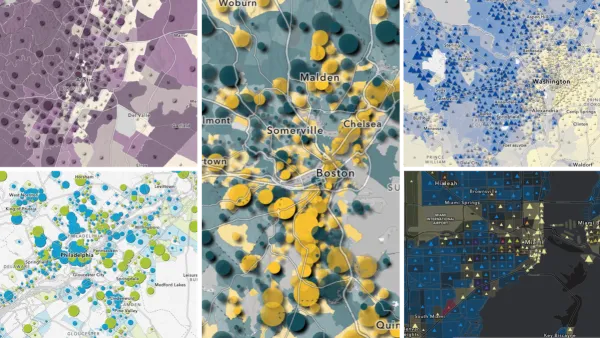
Explore US Demographics With the New ACS Atlas Collection
Esri's new ACS Atlas Collection offers interactive applications that visualize the latest U.S. demographic and socio-economic data, enabling users to explore over 175 curated web maps across various thematic areas.

Planetizen Federal Action Tracker
A weekly monitor of how Trump’s orders and actions are impacting planners and planning in America.

Amtrak, CN end decades-long dispute with eight-year agreement
The new operating agreement establishes an updated framework for the companies to work together, including processes to resolve disputes.

Judges permit Denver to divert 77,000 acre feet from the Colorado River for reservoir expansion
Overuse and climate change have caused the Colorado River’s water levels to plummet.

NYC DOT wants faster, more permanent street upgrades
The city is examining ways to build more concrete infrastructure without getting entangled in 'decades-long' projects.

'Something we’ve never seen before:' rising utility rates could strain city finances nationwide
Data centers, climate change and other factors have caused utility rates in the United States to increase by 38% since 2020.

Trump to overrule local leaders, lease millions of acres of America’s Pacific Island territories’ seafloors to mining companies
International law says that the Indigenous people of America’s territories have a right to prior and informed consent regarding projects that impact their countries.

FREE Course: Walkable City 1: Why Walkability?
After describing his path towards focusing on walkability as the essence of good planning, Jeff Speck marches through his five principal reasons for making more walkable places.
Reinventing Malls: Planning Alchemy—Turning Gray Fields Into Gold
The course focuses on the opportunities and imperatives that shape reinvention of mall sites.

Harvard University Graduate School of Design
KFH Group Inc.
Greater Baltimore Committee
The Architects Foundation
University of Cincinnati Online
The Pocatello Development Authority
The Urban Renewal Agency of the City of Pocatello