On September 16, California's newest bicycle law went into effect, the "Three Feet for Safety Act" law. However, most motorists are unaware of it. Maybe a new sign will help.


"It's been less than two weeks since California motorists were ordered to give bicyclist more room on the road and in that time frame, at least one Bay Area cyclist has died after colliding with a car," writes Natalie Neysa Alund of the Bay Area News Group, who goes on to report some of the most recent collisions in the Bay Area that cyclists have experienced since the law went into effect on September 16.
What she found was that few drivers were aware of the new law. But help is on the way.
California Bicycle Coalition's Executive Director David Snyder said that on (September 25), the state Traffic Devices Control Committee approved a new sign that will go up along roadways to make sure motorists are aware of the new law.

credit: California Bicycle Coalition - image only.
Will the new law and new signage reduce bicycle collisions? Hopefully, because bicycle fatalities have been increasing.
According to the California Highway Patrol, 153 bicyclists were killed in collisions with motor vehicles in the state in 2012 -- a 7 percent increase from 2011. Those deaths account for about 5 percent of the state's traffic fatalities.
Regardless of whether the new law does stem bicycle collisions, which "can be evaluated after there is historical data," stated Sgt. Mark Dang, with Fremont Police Department's traffic unit, he noted another contribution it will have. "This law will raise awareness ... and awareness is positive," he added.
Read the full story: At least one Bay Area cyclist has died since the three-feet law went into effect

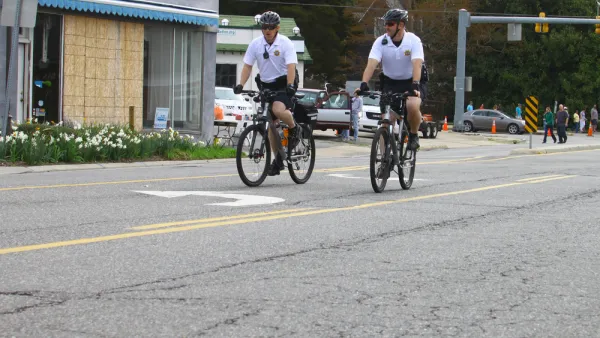
Virginia's Proposed Bicycle Safety Act Puts the Onus on Drivers
Three-foot passing rules are safe. Requiring drivers to change lanes to pass people on bikes are even safer.
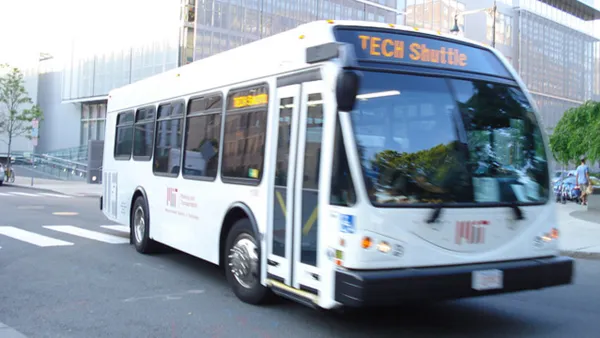
Tech Buses: Not Just for Techies, and Not Just for San Francisco
What began as Google buses, transporting highly paid engineers from San Francisco to Silicon Valley, has transformed into multi-company fleets serving white- and blue-collar workers in the 3,000-square-mile Northern California megaregion.
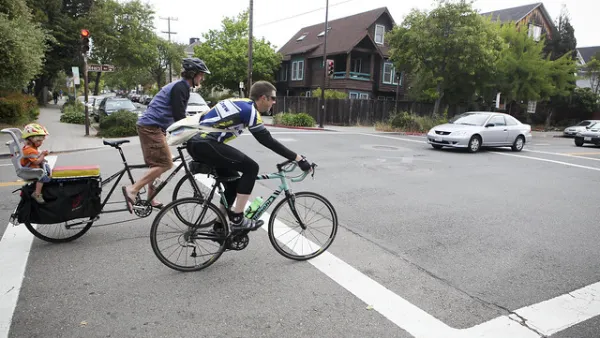
City to Bicyclists: Berkeley Not in Idaho
Berkeley, California might have a reputation of a very progressive city, but when it comes to cycling, it appears to have little tolerance for cyclists who roll through stop signs. Police are justifying the crackdown on the terms of a state grant.

Planetizen Federal Action Tracker
A weekly monitor of how Trump’s orders and actions are impacting planners and planning in America.

Amtrak, CN end decades-long dispute with eight-year agreement
The new operating agreement establishes an updated framework for the companies to work together, including processes to resolve disputes.

Judges permit Denver to divert 77,000 acre feet from the Colorado River for reservoir expansion
Overuse and climate change have caused the Colorado River’s water levels to plummet.

NYC DOT wants faster, more permanent street upgrades
The city is examining ways to build more concrete infrastructure without getting entangled in 'decades-long' projects.

'Something we’ve never seen before:' rising utility rates could strain city finances nationwide
Data centers, climate change and other factors have caused utility rates in the United States to increase by 38% since 2020.

Trump to overrule local leaders, lease millions of acres of America’s Pacific Island territories’ seafloors to mining companies
International law says that the Indigenous people of America’s territories have a right to prior and informed consent regarding projects that impact their countries.

FREE Course: Walkable City 1: Why Walkability?
After describing his path towards focusing on walkability as the essence of good planning, Jeff Speck marches through his five principal reasons for making more walkable places.
Reinventing Malls: Planning Alchemy—Turning Gray Fields Into Gold
The course focuses on the opportunities and imperatives that shape reinvention of mall sites.

Harvard University Graduate School of Design
KFH Group Inc.
Greater Baltimore Committee
The Architects Foundation
University of Cincinnati Online
The Pocatello Development Authority
The Urban Renewal Agency of the City of Pocatello