Nate Berg details the "eHighway" road design project that will move goods away from the ports of Los Angeles and Long Beach.


Nate Berg reports that the eHighway experiment in Southern California is "being built along a mile of the [Alameda] corridor to test how highly polluting diesel truck traffic could instead run on emission-free electric power."
"If successful, this demonstration could offer a solution to pollution-related problems along the Alameda Corridor and other high-traffic roadways all over the world."
The $13 million "electrified catenary system" is a result of a contract between Siemens and the South Coast Air Quality Management District. According to Berg, the eHighway "will run along the outside lanes of both sides of the road, sort of like the overhead wires that provide power to electric buses, trolleys, and trains in cities."
"SCAQMD will then conduct a yearlong test of the system using up to four different trucks, each with a different engine type and fuel source."
Read the full story: Los Angeles Is Building an e-Highway

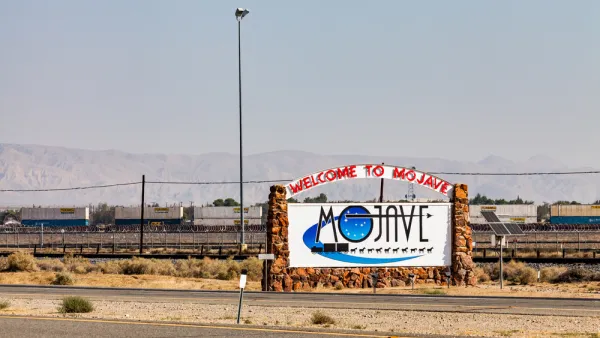
Inland Port Planned for Mojave Desert
California’s Kern County approved plans to build a 410-acre logistics hub to expand capacity for cargo coming from the ports of Los Angeles and Long Beach.

Port Logjam Contributing to Dismal L.A. Air Quality
Emissions from container ships idling outside Southern California's ports are adding to pollution that has blanketed the region in a noxious layer of smog.

Zoning and the Global Supply Shortage
Zoning has been blamed for a lot of things in recent years, but a global supply crunch increasing prices and creating shortages of household goods—and potentially ruining the holidays—is a new one.

Planetizen Federal Action Tracker
A weekly monitor of how Trump’s orders and actions are impacting planners and planning in America.

California plans to bury El Niño’s downpour
If the state plays its cards right, it may be able to store a billion acre-feet of El Niño’s water in aquifers.

Chicago breaks ground on $3 billion megadevelopment
The new neighborhood, titled Foundry Park, will one day host 3,700 residences.

California High-Speed Rail Authority CEO resigns after $600,000 scandal
Under Ian Choudri, the authority used taxpayer dollars to fund first class flights and trips to nightclubs.

Want to study the Missouri River? Soon, you may need unanimous approval from 10 states
Legislation would require 10 governors’ permission to study or build projects moving water outside the basin.

Desperate measures: Advocates weigh draining Lake Powell to fill Colorado River
Draining the reservoir could reduce evaporation losses by a couple hundred thousand acre-feet.

FREE Course: Walkable City 1: Why Walkability?
After describing his path towards focusing on walkability as the essence of good planning, Jeff Speck marches through his five principal reasons for making more walkable places.
Reinventing Malls: Planning Alchemy—Turning Gray Fields Into Gold
The course focuses on the opportunities and imperatives that shape reinvention of mall sites.

City of Rosemead
Rutgers University, Edward J. Bloustein School of Planning and Public Policy
One Hundred Miles
Hunter College, City University of New York (CUNY)
The Architects Foundation
University of Cincinnati Online
City of Cambridge
Montrose County
The Pocatello Development Authority