When former San Antonio Mayor Julian Castro began his new job as secretary of HUD, the all-but-built Modern Streetcar project fell prey to gathering Tea Party forces.


David Martin Davies updates the quick and surprising twists in the fallout from former San Antonio Mayor Julian Castro's new position as secretary of the U.S. Department of Housing and Urban Development.
On July 28, former San Antonio Mayor Julian Castro raised his right hand and was sworn in as the new secretary of the U.S. Department of Housing and Urban Development. That same day, back in the Alamo City, one of Castro’s signature programs, the 'Modern Streetcar' project, was going off the rails, undone by the very leaders who’d once backed it.
The 5.9-mile project would have totaled $280 million, with $32 million coming from the city. The first phase of the system would have included two lines around Downtown as well as connections to the Westside Multimodal Center and north along Broadway to the "thriving" Pearl Brewery development.
The article reads like an autopsy of the slowly gathering political forces, some of them leveraging the streetcar as means for other ends, that finally put an end to the streetcar project.
Read the full story: A Desire Named Streetcar
San Antonio Streetcar Plans at Risk
San Antonio Mayor Ivy Taylor is calling for a "pause" on the city's proposed streetcar. Meanwhile a charter amendment from project opponents could be headed to the ballot and a county judge has called for the project to be put on hold.
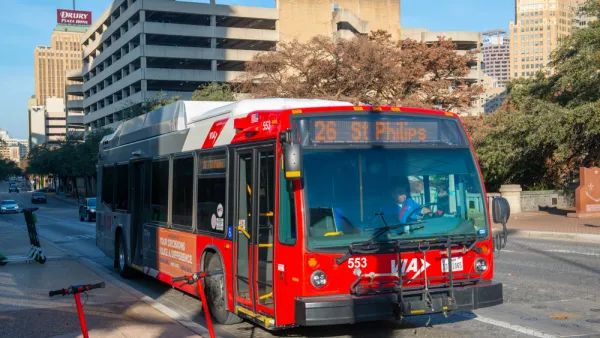
Better Transit Service, More Transit Riders
San Antonio's investment in more frequent service on several popular routes has resulted in many more riders.

San Antonio approves $1.1 billion transit agenda
The agency has also begun construction of its Via Rapid Green line, which will service passengers from the San Antonio International Airport.

Planetizen Federal Action Tracker
A weekly monitor of how Trump’s orders and actions are impacting planners and planning in America.

California plans to bury El Niño’s downpour
If the state plays its cards right, it may be able to store a billion acre-feet of El Niño’s water in aquifers.

Desperate measures: Advocates weigh draining Lake Powell to fill Colorado River
Draining the reservoir could reduce evaporation losses by a couple hundred thousand acre-feet.

Los Angeles just elected an urban planner as its mayor
Transportation analysts are optimistic that Raman will be more aggressive in addressing transit issues than Bass.

Mamdani’s pied-à-terre tax survives legal challenge
A panel of judges found that the plaintiffs failed to demonstrate injury as a result of New York City's implementation of the tax.

Eastern Nebraska is running out of electricity
Data centers and electrification are straining eastern Nebraska’s grid, throttling economic development.

FREE Course: Walkable City 1: Why Walkability?
After describing his path towards focusing on walkability as the essence of good planning, Jeff Speck marches through his five principal reasons for making more walkable places.
Reinventing Malls: Planning Alchemy—Turning Gray Fields Into Gold
The course focuses on the opportunities and imperatives that shape reinvention of mall sites.

City of Rosemead
Rutgers University, Edward J. Bloustein School of Planning and Public Policy
One Hundred Miles
University of Michigan School for Environment and Sustainability (SEAS)
Hunter College, City University of New York (CUNY)
The Architects Foundation
City of Cambridge
Montrose County
The Pocatello Development Authority