Following a controversy over annexation on the northwest boundary of Boise back in July, an Idaho Statesman article examines the prospect (and history) of plans to annex a much more populated area to the city's southwest.


"It won't happen this year, and it might not happen next year, but eventually, Boise will move to annex the 6,000 homes and roughly 27,000 people living in [the Southwest Planning Area of Ada County]. The land has been in the city's area of impact - meaning it's been identified for annexation - for 36 years," reports Sven Berg.
In question is the use of resources, such as parks, by residents of the unincorporated area of Ada County, as well as county taxes on city residents that are then spent on resources for county residents, such as the Sheriff's Office.
The idea of annexation is unpopular with county residents, who think they will gain less than they'll pay for if they have to start paying the city's taxes.
Land use planning decisions dating back to the 1970s have allowed for city levels of density in Boise's unincorporated "areas of impact."
Read the full story: Southwest Planning Area braces for Boise's advance
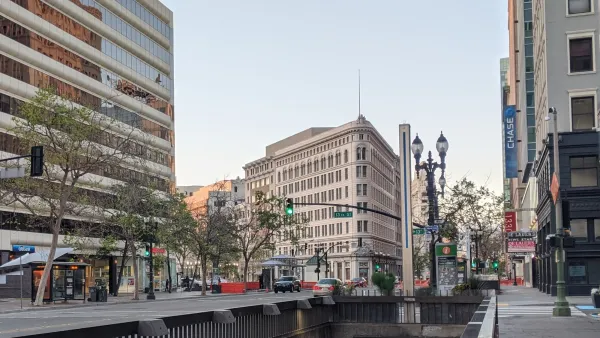
Oakland Drafts First Revision of General Plan Since 1998
The public has until April 23 to comment on the sweeping plan that addresses land use, transportation, and infrastructure.

Land Use: Chasing Utopia, 2025?
History has taught us the risks of undervaluing the power of planning decisions. Overvaluing them might be just as dangerous.

New Idaho Laws Block Three Boise Complete Streets Projects
State law now bars highway districts from reducing road widths or and limits where they can eliminate traffic lanes in favor of multimodal infrastructure.

Planetizen Federal Action Tracker
A weekly monitor of how Trump’s orders and actions are impacting planners and planning in America.

California plans to bury El Niño’s downpour
If the state plays its cards right, it may be able to store a billion acre-feet of El Niño’s water in aquifers.

Desperate measures: Advocates weigh draining Lake Powell to fill Colorado River
Draining the reservoir could reduce evaporation losses by a couple hundred thousand acre-feet.

Mamdani’s pied-à-terre tax survives legal challenge
A panel of judges found that the plaintiffs failed to demonstrate injury as a result of New York City's implementation of the tax.

Eastern Nebraska is running out of electricity
Data centers and electrification are straining eastern Nebraska’s grid, throttling economic development.

Seattle passes record-breaking transit services expansion
Proposition 1 will double the city’s transit tax to add 95,000 more bus trips and preserve 180,000 bus trips annually.

FREE Course: Walkable City 1: Why Walkability?
After describing his path towards focusing on walkability as the essence of good planning, Jeff Speck marches through his five principal reasons for making more walkable places.
Reinventing Malls: Planning Alchemy—Turning Gray Fields Into Gold
The course focuses on the opportunities and imperatives that shape reinvention of mall sites.

City of Rosemead
Rutgers University, Edward J. Bloustein School of Planning and Public Policy
One Hundred Miles
University of Michigan School for Environment and Sustainability (SEAS)
Hunter College, City University of New York (CUNY)
The Architects Foundation
City of Cambridge
Montrose County
The Pocatello Development Authority