Owners of a 173-acre office campus in Simsbury, Connecticut are hoping that by adopting a form-based code as a guide for potential redevelopment of the site, potential buyers have more reason to pull the trigger on a deal.


"Hartford Financial Services Group Inc. and the town of Simsbury have entered a pivotal phase in the insurer's efforts to sell its sprawling Farmington Valley office campus on 173 acres at 200 Hopmeadow St.," reports Gregory Seay.
"The town, after months of collaboration with The Hartford, its listing broker, CBRE-New England, and other land-use advisers and town residents, recently approved a form-based code that ensures whoever acquires all or part of the site designs and builds on it in a way that maximizes its value to them, users and the town, realty and land-use experts say."
One of those land use experts is Scott Polikov, founding principal of Gateway Planning Group of Dallas, which is advising The Hartford on the sale. Polikov is quoted in the story: "This is breaking new ground in terms of using a design process to calibrate form-based code so that the business interest of the property owner and the public's interests are brought together…''
Read the full story: The Stag bets 'form-based code' can sell Simsbury campus
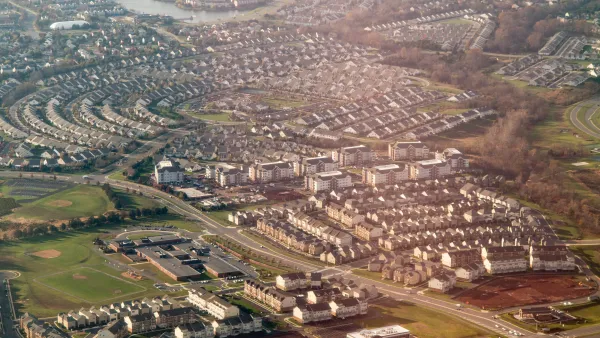
Retrofitting D.C.’s Suburbs for a New Era
How to equip suburban sprawl for a different future.
Coming Soon to Dallas-Fort Worth: 8 Million Square Feet of Office Buildings
Large corporations are making huge investments in new office parks in the Dallas-Fort Worth area, reflecting a desire to attract young talent with Google- and Facebook-like workplaces.

Chicago's Golden Goose
Once known as "Little Hell" for its copious industrial plants, Goose Island is a rare, relatively undeveloped investment opportunity. Centrally located, it may one day house swanky offices.

Planetizen Federal Action Tracker
A weekly monitor of how Trump’s orders and actions are impacting planners and planning in America.

Eastern Nebraska is running out of electricity
Data centers and electrification are straining eastern Nebraska’s grid, throttling economic development.

Study reveals best places in the U.S. for cycling, walking
New research from Streetlight Data examines bicycle and pedestrian miles per capita in the 100 largest U.S. cities by population.

Federal government nominates new FTA administrator
Mark Aesch is currently the founder and CEO of a transportation management consulting firm.

Developers reveal $10 billion stadium plan as ‘Hail Mary’ to keep Bears in Chicago
The plan would also boast a public park, high- and mid-rise buildings and a youth sports complex.

As Texas embraces carbon storage, a Black community questions the risks
Texas now issues permits for companies to store carbon dioxide underground. East Texas residents fear safety risks, and skeptics doubt the climate benefits.

FREE Course: Walkable City 1: Why Walkability?
After describing his path towards focusing on walkability as the essence of good planning, Jeff Speck marches through his five principal reasons for making more walkable places.
Reinventing Malls: Planning Alchemy—Turning Gray Fields Into Gold
The course focuses on the opportunities and imperatives that shape reinvention of mall sites.

City of Rosemead
Rutgers University, Edward J. Bloustein School of Planning and Public Policy
One Hundred Miles
University of Michigan School for Environment and Sustainability (SEAS)
Hunter College, City University of New York (CUNY)
The Architects Foundation
City of Cambridge
The Pocatello Development Authority
The Urban Renewal Agency of the City of Pocatello