California planning expert Bill Fulton discusses a long-awaited proposal from the Governor's Office of Planning and Research that would shift the state's traffic impact assessments away from their current focus on traffic congestion.


A sweeping set of recommendations for a new traffic impact assessment standard appeared late Wednesday from the California Governor's Office of Planning and Research. Under the proposal, traffic congestion would no longer be considered a significant environmental impact under the California Environmental Quality Act, and expanded roadways in congested areas would be assessed for possible growth-inducing impacts.
The recommendation would replace the “level of service” traffic congestion standard with a “vehicle miles traveled” standard in order to tether CEQA analysis more closely to other state goals, especially the greenhouse gas emissions reduction goals contained in AB 32, the state’s climate change law.
If adopted, the recommendations could have widespread implications for how traffic is mitigated under CEQA and the leverage local governments have over developers in dealing with traffic congestion issues.
Read the full story: OPR's new traffic draft rethinks congestion

Experts Weigh in on Decision to Move California to VMT as Metric for Impacts
In a significant effort to shift from sprawl toward incentivizing low-carbon transportation options, California is revising the way it measures traffic impacts of development projects under its Environmental Quality Act.
Traveling beyond LOS (By foot? On a bike?)
Let me start with a disclaimer: I am not a transportation planner. At the points where transportation planning shares borders with engineering, I tend to zone out and start doodling in the margins. I do, however, have a lifelong interest in transportation, which is why I share the excitement of some of my more transportation-focused colleagues about potential changes in how California measures transportation impacts of projects.
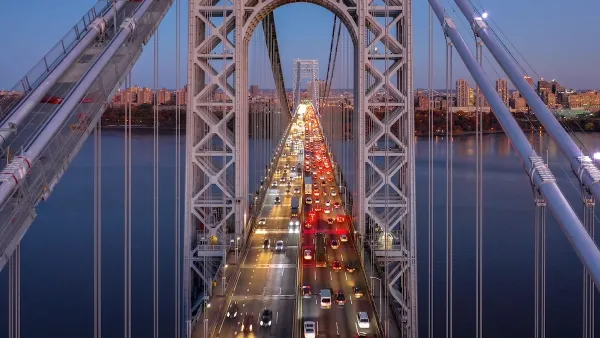
Vehicle Miles Travelled, Level of Service, and a Soon-to-be-Insolvent Transportation Trust Fund
Level of Service and the gas tax have served our transportation needs for a long time. Now, it’s time for a change.

Planetizen Federal Action Tracker
A weekly monitor of how Trump’s orders and actions are impacting planners and planning in America.

Amtrak, CN end decades-long dispute with eight-year agreement
The new operating agreement establishes an updated framework for the companies to work together, including processes to resolve disputes.

Judges permit Denver to divert 77,000 acre feet from the Colorado River for reservoir expansion
Overuse and climate change have caused the Colorado River’s water levels to plummet.

NYC DOT wants faster, more permanent street upgrades
The city is examining ways to build more concrete infrastructure without getting entangled in 'decades-long' projects.

'Something we’ve never seen before:' rising utility rates could strain city finances nationwide
Data centers, climate change and other factors have caused utility rates in the United States to increase by 38% since 2020.

Trump to overrule local leaders, lease millions of acres of America’s Pacific Island territories’ seafloors to mining companies
International law says that the Indigenous people of America’s territories have a right to prior and informed consent regarding projects that impact their countries.

FREE Course: Walkable City 1: Why Walkability?
After describing his path towards focusing on walkability as the essence of good planning, Jeff Speck marches through his five principal reasons for making more walkable places.
Reinventing Malls: Planning Alchemy—Turning Gray Fields Into Gold
The course focuses on the opportunities and imperatives that shape reinvention of mall sites.

Harvard University Graduate School of Design
KFH Group Inc.
Greater Baltimore Committee
The Architects Foundation
University of Cincinnati Online
The Pocatello Development Authority
The Urban Renewal Agency of the City of Pocatello