Although the skateboard's been around for a while, recent modifications to traditional designs are targeting skateboards for an older, wealthier demographic.


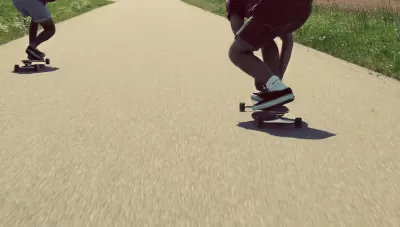
Conor Dougherty reports on the newest trend in multi-modal commuting: skateboards. "Here in Silicon Valley, inventors are tinkering with a revolutionary transportation technology. It's called a skateboard," reports Dougherty with tongue—at least a little bit—in cheek.
"Witness a sampling of new electric skateboards and skateboard-like contraptions: There's the Boosted board, whose feisty motor can rocket up hills. Also the ZBoard, which is slower and wider but has big fat wheels to plow over pebbles and debris. Then there are oddballs like the Onewheel, a "self-balancing electric skateboard" that looks like a teeter-totter, works like a Segway and isn't really a skateboard."
But the new era of skateboarding isn't designed for your typical teen in a Ramones t-shirt: "None of this stuff is aimed at what you might call real skateboarders. Instead it is for the growing number of urban professionals who don't want to drive to work."
Read the full story: No Longer for Punks, Skateboards Cater to Yuppie Commuters
Will Millennials Remake Suburbs in Their Image?
The "hipsterification" of cities is a well-known phenomenon. But as the millennial generation ages and settles down, will they import that same cultural ethos to locations more suburban?
What Millennials Want: A Multi-Modal City
A recent study finds evidence of an overwhelming desire by Millennials to live multi-modal, car-lite lifestyles. They're even prepared to move to find what they want.
Hipsters Flee as Invasion of the Baby Boomers Picks Up Speed
In the hip neighborhoods of Brooklyn, Seattle, and Denver, a silver tsunami is joining, and often forcing out, tattooed and mustachioed Millennials, as retiring Baby Boomers increasingly embrace urban living.

Planetizen Federal Action Tracker
A weekly monitor of how Trump’s orders and actions are impacting planners and planning in America.

California plans to bury El Niño’s downpour
If the state plays its cards right, it may be able to store a billion acre-feet of El Niño’s water in aquifers.

Desperate measures: Advocates weigh draining Lake Powell to fill Colorado River
Draining the reservoir could reduce evaporation losses by a couple hundred thousand acre-feet.

Chicago voters approve permanent festival grounds, penalty for vacant property owners
Currently, major summer and fall festivals take over public parks for weeks at a time, drawing criticism from nearby residents

NYC votes to cut outdoor dining red tape, speed up permitting
New York City also voted to allow the Department of Transportation to begin work on urgent projects before notifying elected officials.

California appears to reject Prop. 45
The proposition would have expanded the projects that qualify for a streamlined environmental review, effectively paring down the California Environmental Quality Act.

FREE Course: Walkable City 1: Why Walkability?
After describing his path towards focusing on walkability as the essence of good planning, Jeff Speck marches through his five principal reasons for making more walkable places.
Reinventing Malls: Planning Alchemy—Turning Gray Fields Into Gold
The course focuses on the opportunities and imperatives that shape reinvention of mall sites.

City of Rosemead
Rutgers University, Edward J. Bloustein School of Planning and Public Policy
One Hundred Miles
Hunter College, City University of New York (CUNY)
The Architects Foundation
University of Cincinnati Online
City of Cambridge
Montrose County
The Pocatello Development Authority