The modernist designer Massimo Vignelli, who created the 1972 version of the New York City Subway map, passed away this week at 83.


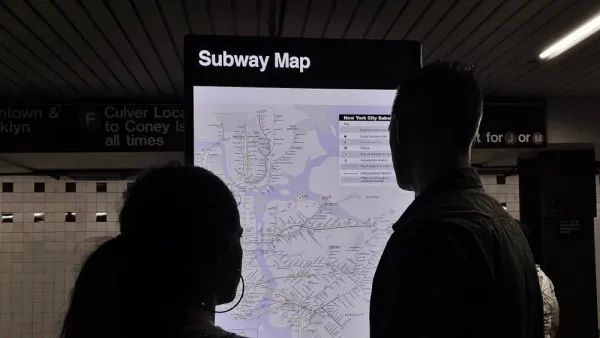
To honor Vignelli's passing, Will Doig presents seven creative and lesser-known versions of the New York City Subway system that fans of transit, maps, and New York City (but not necessarily in that order) will enjoy. A sample of the subway system, as presented in these unique representations:
- "When the current New York subway map was introduced in 1979, designer Nobu Siraisi quickly recognized what a mess it was around the Atlantic Avenue station in Brooklyn. So Siraisi redrew that section of the map by hand, in a sketch that never made it off the drawing board, but is somehow gorgeous in its simplicity."
- "For 'I Love NY' in map form, Seoul-based designers Zero Per Zero embeded [sic] New York’s transit system into a heart shape, rendering it cuddlier than it probably has a right to be."
- The article also includes a video of "the New York subway map as string instrument, using the actual train schedule to create the symphony."
Read the full story: 7 Alternate Versions of the New York City Subway Map
The New York Subway Map, Explained
An interactive feature reveals the origins and design choices of the New York Subway map.
Legendary Map Designer Disses Competition
At a recent talk at the New York City Transit Museum, Massimo Vignelli, designer of the iconic 1972 NYC subway map, discussed his opinions of the subway maps that preceded and followed his groundbreaking design.

Mamdani’s pied-à-terre tax survives legal challenge
A panel of judges found that the plaintiffs failed to demonstrate injury as a result of New York City's implementation of the tax.

Planetizen Federal Action Tracker
A weekly monitor of how Trump’s orders and actions are impacting planners and planning in America.

California plans to bury El Niño’s downpour
If the state plays its cards right, it may be able to store a billion acre-feet of El Niño’s water in aquifers.

Desperate measures: Advocates weigh draining Lake Powell to fill Colorado River
Draining the reservoir could reduce evaporation losses by a couple hundred thousand acre-feet.

Los Angeles just elected an urban planner as its mayor
Transportation analysts are optimistic that Raman will be more aggressive in addressing transit issues than Bass.

Mamdani’s pied-à-terre tax survives legal challenge
A panel of judges found that the plaintiffs failed to demonstrate injury as a result of New York City's implementation of the tax.

Eastern Nebraska is running out of electricity
Data centers and electrification are straining eastern Nebraska’s grid, throttling economic development.

FREE Course: Walkable City 1: Why Walkability?
After describing his path towards focusing on walkability as the essence of good planning, Jeff Speck marches through his five principal reasons for making more walkable places.
Reinventing Malls: Planning Alchemy—Turning Gray Fields Into Gold
The course focuses on the opportunities and imperatives that shape reinvention of mall sites.

City of Rosemead
Rutgers University, Edward J. Bloustein School of Planning and Public Policy
One Hundred Miles
University of Michigan School for Environment and Sustainability (SEAS)
Hunter College, City University of New York (CUNY)
The Architects Foundation
City of Cambridge
Montrose County
The Pocatello Development Authority