The planned Southwest LRT connection between Minneapolis and St. Louis Park is troubled by controversy and a ballooning costs. One writer recently tried to redirect the conversation about the light rail line.


Bill Lindeke argues in a recent editorial that the ongoing debate about the planned Southwest LRT connecting Minneapolis to St. Louis Park is all wrong. To redirect the conversation, Lindeke frames the Southwest debate according to what it is "NOT about," and then what Southwest "IS about."
According to Lindeke, the Southwest Light Rail debate has almost nothing to do with bikes, as some have suggested recently, and more to do with the broken nature of federal funding—and its effect among local politicians. Here's more details on the latter point: "Most everyone admits that the project as a whole is borderline absurd. If given a blank slate, nobody would decide to spend hundreds of millions to build tunnels through a forest. And yet it’s probably going to happen anyway! And why? Because there’s so much Federal money on the table. Cities and politicians are extremely reluctant to turn away $700+ Million in Federal funding (and for good reason)."
Read the full story: What Southwest Light Rail conversations get wrong
Questioning the 'Wisdom of Crowds' in Minneapolis
In a familiar refrain for anyone who's lamented the veto power of NIMBYs or the added cost of citizen engagement events, one writer expresses concerned about a recent succession of developments shot down by community groups in the Twin Cities.
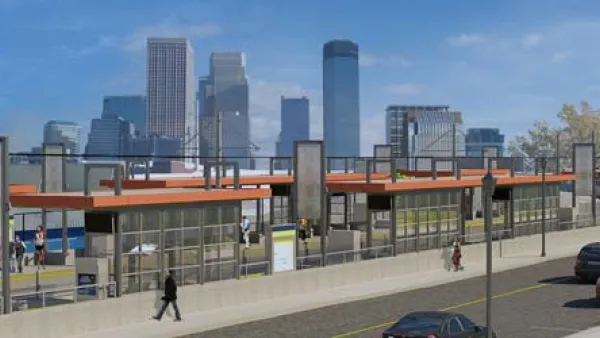
Minneapolis LRT Facing Delays, Cost Increases
Construction on the Kenilworth Tunnel has been plagued by problems and threatens the foundation of a nearby condo complex.
Contractors in Limbo While Southwest LRT Waits for Federal Funding Promise
More evidence that the Federal Transit Administration under the Trump Administration isn't interested in capital investments.

Planetizen Federal Action Tracker
A weekly monitor of how Trump’s orders and actions are impacting planners and planning in America.

Washington state to charge fee to drivers with fuel-efficient cars
Revenue from the fee will go towards supporting the state’s highways.

Illinois considers spending $1 billion in taxpayer money on data center
A quantum computing campus and data center are currently under construction in Chicago.

Did data centers change how voters cast their ballots?
Texas, Ohio, and Georgia all flipped party control. But in rural counties, the effect of local data centers was mixed.

Amtrak invests in eight new Airo trainsets
The new trainsets will begin serving passengers in 2031.

HUD to end aid for mixed-immigration-status households
The new rule is projected to impact 80,000 people, nearly half of whom are children.

FREE Course: Walkable City 1: Why Walkability?
After describing his path towards focusing on walkability as the essence of good planning, Jeff Speck marches through his five principal reasons for making more walkable places.
Reinventing Malls: Planning Alchemy—Turning Gray Fields Into Gold
The course focuses on the opportunities and imperatives that shape reinvention of mall sites.

City of Charlotte
City of Rosemead
Rutgers University, Edward J. Bloustein School of Planning and Public Policy
University of Michigan School for Environment and Sustainability (SEAS)
Hunter College, City University of New York (CUNY)
The Architects Foundation
University District Partnership