Los Angeles Deputy Mayor for Budget and Innovation Rick Cole shares his views on the critical ingredients necessary for the city to improve its thoroughfares at a Urban Land Institute-Los Angeles’ panel discussion titled "Can LA’s Streets Be Great?"


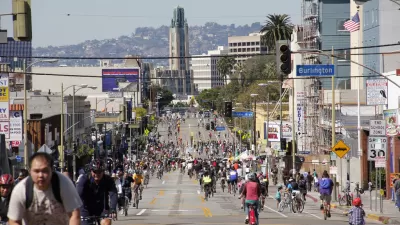
Los Angeles Deputy Mayor for Budget and Innovation Rick Cole shared his views on the critical ingredients necessary for the city to improve its thoroughfares at the Urban Land Institute-Los Angeles’ panel discussion on February 19 at Gensler titled "StimULI: Can LA’s Streets Be Great?" Jack Skelley, a member of ULI-LA’s Executive Committee, moderated the conversation. The Planning Report has included an edited transcription of Cole’s remarks, which touch on the central importance of investment and the role of the flâneur in creating vibrant streets. Speaking ahead of Cole were Councilmember José Huizar and City of Los Angeles Deputy Mayor Doane Liu.
Often maligned by armchair urbanists for its car culture, Los Angeles has made strides in recent years, through investments in public transportation and in its downtown, in improving walkability and public space. Mayor Eric Garcetti's launch of the Great Streets Initiative in October 2013 aims to carry these improvements further with a focus on corridors throughout the city. An executive directive by the mayor created a working group of relevant city departments to first focus on coordinating work ("No more Bureau of Street Services paving a street on Monday, DWP digging it up on Tuesday," said Mayor Garcetti), identifying streets, and establishing timelines.
Read the full story: Can LA’s Streets Be Great? LA Deputy Mayor Rick Cole Opines
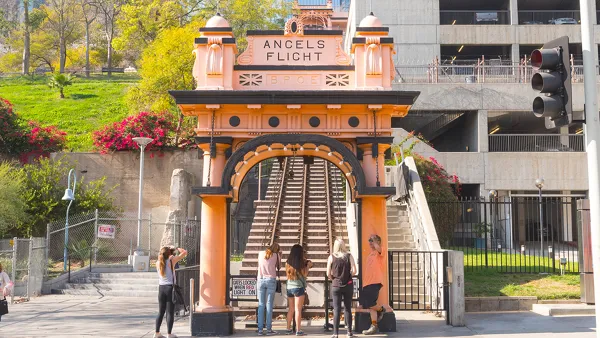
Los Angeles' Iconic Angels Flight Railway To Utilize P3 Model
After appearing in the film La La Land, the world-renowned, iconic, 116-year-old Angels Flight will reopen to the public after a three-year modernization process.
Los Angeles' Plan to Minimize Displacement During Urban Revitalization
Bloomberg Philanthropies will fund an "Innovation Delivery Team" in Los Angeles to approach the challenge of revitalizing urban neighborhoods while also creating improvements for existing populations.
The Impossibility of Updating Los Angeles’ Community Plans
Despite years of community engagement, political discussion, and planning, the city of Los Angeles has struggled to pass updated community plans, and in many neighborhoods, developments may suffer through years of litigation and bureaucracy.

Planetizen Federal Action Tracker
A weekly monitor of how Trump’s orders and actions are impacting planners and planning in America.

California plans to bury El Niño’s downpour
If the state plays its cards right, it may be able to store a billion acre-feet of El Niño’s water in aquifers.

Desperate measures: Advocates weigh draining Lake Powell to fill Colorado River
Draining the reservoir could reduce evaporation losses by a couple hundred thousand acre-feet.

Los Angeles just elected an urban planner as its mayor
Transportation analysts are optimistic that Raman will be more aggressive in addressing transit issues than Bass.

Mamdani’s pied-à-terre tax survives legal challenge
A panel of judges found that the plaintiffs failed to demonstrate injury as a result of New York City's implementation of the tax.

Eastern Nebraska is running out of electricity
Data centers and electrification are straining eastern Nebraska’s grid, throttling economic development.

FREE Course: Walkable City 1: Why Walkability?
After describing his path towards focusing on walkability as the essence of good planning, Jeff Speck marches through his five principal reasons for making more walkable places.
Reinventing Malls: Planning Alchemy—Turning Gray Fields Into Gold
The course focuses on the opportunities and imperatives that shape reinvention of mall sites.

City of Rosemead
Rutgers University, Edward J. Bloustein School of Planning and Public Policy
One Hundred Miles
University of Michigan School for Environment and Sustainability (SEAS)
Hunter College, City University of New York (CUNY)
The Architects Foundation
City of Cambridge
Montrose County
The Pocatello Development Authority