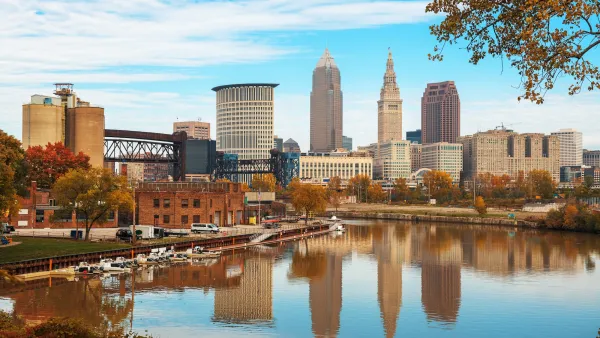
United Airlines recently decided to eliminate its hub at Cleveland Hopkins International Airport. Some are hoping the city will shift traffic from the Burke Lakefront Airport into Hopkins, freeing up lakefront property for development.


Leila Atassi reports that Cleveland Mayor Frank Jackson might be wavering on an earlier stand against closing Burke Lakefront Airport to free up the airport’s land for development.
The possibility arose after United Airlines announced that it would eliminate its hub at Cleveland Hopkins International Airport, freeing up Concourse D to potentially absorb Burke's 75,000-80,000 yearly landings and take-offs.
Although Mayor Jackson has presented plans for lakefront development that denied the possibility of developing the Burke property, he seemed to step back from those claims at a recent city council hearing, according to Attasi’s article.
Even if the Burke property is developed, it won’t be any time soon, according to Mayor Jackson. “[The] cost of dealing with the environmental hazards of the site, a former landfill, wouldn’t make sense financially for most developers, and [Jackson] added that he did not believe that inviting more air traffic to Hopkins would resolve the conundrum of what to do with Concourse D.”
Read the full story: Cleveland City Council prods mayor on possibilities for land beneath Burke Lakefront Airport

Learning loss and urban schools, part 2
Did test scores in progressive cities drop more post-COVID than test scores in moderate ones?

Cleveland is turning abandoned real estate into ‘housing innovation district,’ jobs
The city’s housing innovation district will bring pro-housing policies to disinvested neighborhoods.
Cleveland program has housed 200 people since 2024
The A Home For Every Neighbor initiative successfully moves people into housing in under two weeks.

Planetizen Federal Action Tracker
A weekly monitor of how Trump’s orders and actions are impacting planners and planning in America.

California plans to bury El Niño’s downpour
If the state plays its cards right, it may be able to store a billion acre-feet of El Niño’s water in aquifers.

Desperate measures: Advocates weigh draining Lake Powell to fill Colorado River
Draining the reservoir could reduce evaporation losses by a couple hundred thousand acre-feet.

Mamdani’s pied-à-terre tax survives legal challenge
A panel of judges found that the plaintiffs failed to demonstrate injury as a result of New York City's implementation of the tax.

Eastern Nebraska is running out of electricity
Data centers and electrification are straining eastern Nebraska’s grid, throttling economic development.

Seattle passes record-breaking transit services expansion
Proposition 1 will double the city’s transit tax to add 95,000 more bus trips and preserve 180,000 bus trips annually.

FREE Course: Walkable City 1: Why Walkability?
After describing his path towards focusing on walkability as the essence of good planning, Jeff Speck marches through his five principal reasons for making more walkable places.
Reinventing Malls: Planning Alchemy—Turning Gray Fields Into Gold
The course focuses on the opportunities and imperatives that shape reinvention of mall sites.

City of Rosemead
Rutgers University, Edward J. Bloustein School of Planning and Public Policy
One Hundred Miles
University of Michigan School for Environment and Sustainability (SEAS)
Hunter College, City University of New York (CUNY)
The Architects Foundation
City of Cambridge
Montrose County
The Pocatello Development Authority