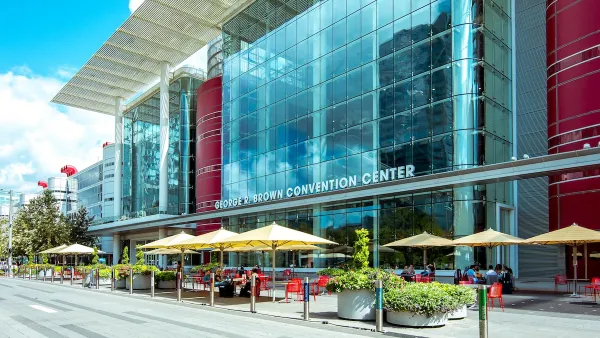
In anticipation of the 2017 Super Bowl, Houston First Corp. is seeking approval of a project to improve the city's convention center and “reshape the once-moribund East End of downtown into a dynamic new focal point of the city.”


“Representatives of Houston First Corp. are proposing to transform the area around the George R. Brown Convention Center into a landscaped and more walkable pedestrian-friendly city center, with more retail and less car traffic, in time for the city to host the NFL's marquee game three years from now,” according to an article by David Kaplan.
Fans of road diets will like the new plans, which call for “opening up the center's look by replacing the front walls with paned glass that allows dramatic views; adding restaurant and retail space and shaded places for people to sit at ground level; and reducing Avenida de las Americas that runs in front to three lanes from eight.”
The project would be funded by Houston First, “the quasi-governmental agency that owns the Hilton Americas Houston and manages more than 10 city-owned buildings including the convention center.” Driving the proposals are the city's plans to host the 2017 Super Bowl (the area could handle an estimated 100,000 “revelers” in the proposed iteration), but the changes are intended to have a long-term impact.
Read the full story: Big changes could be coming to downtown convention center
Houston 'Abandons' Street for Convention Center Expansion
The city plans to eliminate multiple blocks of public streets as part of an expansion project that some residents say didn’t take into account local connectivity.
Convention Center Arms Race Heats Up in Texas
Four major cities in Texas are either considering or constructing convention center upgrades.

Air taxis to connect Texas airports to business hubs
Archer Aviation says its taxis will turn 90 minute drives into 20 minute flights.

Planetizen Federal Action Tracker
A weekly monitor of how Trump’s orders and actions are impacting planners and planning in America.

California plans to bury El Niño’s downpour
If the state plays its cards right, it may be able to store a billion acre-feet of El Niño’s water in aquifers.

Desperate measures: Advocates weigh draining Lake Powell to fill Colorado River
Draining the reservoir could reduce evaporation losses by a couple hundred thousand acre-feet.

Los Angeles just elected an urban planner as its mayor
Transportation analysts are optimistic that Raman will be more aggressive in addressing transit issues than Bass.

Mamdani’s pied-à-terre tax survives legal challenge
A panel of judges found that the plaintiffs failed to demonstrate injury as a result of New York City's implementation of the tax.

Eastern Nebraska is running out of electricity
Data centers and electrification are straining eastern Nebraska’s grid, throttling economic development.

FREE Course: Walkable City 1: Why Walkability?
After describing his path towards focusing on walkability as the essence of good planning, Jeff Speck marches through his five principal reasons for making more walkable places.
Reinventing Malls: Planning Alchemy—Turning Gray Fields Into Gold
The course focuses on the opportunities and imperatives that shape reinvention of mall sites.

City of Rosemead
Rutgers University, Edward J. Bloustein School of Planning and Public Policy
One Hundred Miles
University of Michigan School for Environment and Sustainability (SEAS)
Hunter College, City University of New York (CUNY)
The Architects Foundation
City of Cambridge
Montrose County
The Pocatello Development Authority