Designer Deborah Sussman was drawn to Los Angeles in 1953 by an opportunity to work in the studio of Charles and Ray Eames. Over the next sixty years, she helped to define how residents and others see the city. A new exhibit chronicles her work.


"Last Thursday, the neon sign outside the WUHO Gallery on Hollywood Boulevard was tinted magenta for the opening of Deborah Sussman’s exhibit “Deborah Sussman Loves Los Angeles,” which collects the 82-year-old designer’s work from 1953 to 1984. The shade was chosen to honor the thread of giddy pink that has run through her entire 60-year career," writes Alissa Walker.
With a body of work that includes the "transformative environmental design" for the 1984 Summer Olympics, held in Los Angeles, her impact on how Angelenos and others view the city has been profound, but under-appreciated. "Part of the goal of the exhibition was to bring the designer’s work into the Pinterest age, said the architect and Woodbury University professor Barbara Bestor, one of the exhibition’s curators."
"With a slate of current projects on her desk, including graphics and signage for parks and performing art centers, Sussman shows no sign of slowing down," adds Walker.
Read the full story: On View | The Designer Who Helped Give L.A. Its Look
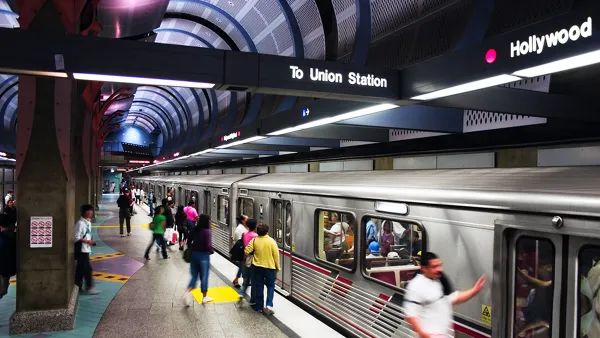
Making Metro Cool
Michael Lejeune is the creative director for the Los Angeles County Metropolitan Transportation Authority, and as such he's tasked with making transit cool in a city that long worshipped the automobile.
L.A. Suing Billboard Magnate Over Supergraphics
Michael McNeilly of SkyTag covered building sides across Los Angeles with multi-story advertisements, disregarding laws prohibiting them. The city is suing SkyTag for millions in penalties.
L.A. Supergraphics Ban Upheld
A federal judge has allowed a citywide ban on new digital billboards and building-sized supergraphics to continue.

Planetizen Federal Action Tracker
A weekly monitor of how Trump’s orders and actions are impacting planners and planning in America.

California plans to bury El Niño’s downpour
If the state plays its cards right, it may be able to store a billion acre-feet of El Niño’s water in aquifers.

Desperate measures: Advocates weigh draining Lake Powell to fill Colorado River
Draining the reservoir could reduce evaporation losses by a couple hundred thousand acre-feet.

Los Angeles just elected an urban planner as its mayor
Transportation analysts are optimistic that Raman will be more aggressive in addressing transit issues than Bass.

Mamdani’s pied-à-terre tax survives legal challenge
A panel of judges found that the plaintiffs failed to demonstrate injury as a result of New York City's implementation of the tax.

Eastern Nebraska is running out of electricity
Data centers and electrification are straining eastern Nebraska’s grid, throttling economic development.

FREE Course: Walkable City 1: Why Walkability?
After describing his path towards focusing on walkability as the essence of good planning, Jeff Speck marches through his five principal reasons for making more walkable places.
Reinventing Malls: Planning Alchemy—Turning Gray Fields Into Gold
The course focuses on the opportunities and imperatives that shape reinvention of mall sites.

City of Rosemead
Rutgers University, Edward J. Bloustein School of Planning and Public Policy
One Hundred Miles
University of Michigan School for Environment and Sustainability (SEAS)
Hunter College, City University of New York (CUNY)
The Architects Foundation
City of Cambridge
Montrose County
The Pocatello Development Authority