Justin Davidson ruminates on the great strides Janette Sadik-Khan and New York's Department of Transportation have made in reforming the city's streets. As much as they've accomplished, the transformation remains a work in progress.


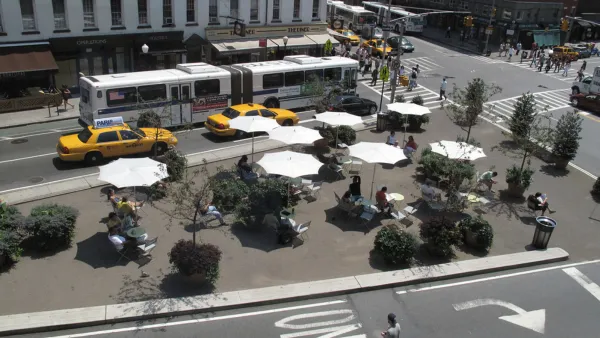
"Making New York’s public spaces safe, civilized, and navigable is a deeply democratic issue," observes Davidson. "If you think that the new street designs are just about giving spandex-encased bikers a high-speed lane of their own or providing tourists with café tables and Wi-Fi, then try shepherding a gaggle of preschoolers across a complicated intersection or pushing a walker across Broadway."
Davidson describes some of the specific elements - from protected bike lanes to curb extensions - that've made New York's streets more accessible to all users. "They’re the work of the Department of Transportation, whose outgoing head, Janette Sadik-Khan, turned an agency devoted to painting bridges and fixing potholes into a platform for social activism."
But reforming the city's streets is "nowhere near complete," he adds. In addition to a backlog of necessary repairs, he identifies several areas of need, including "find[ing] a way for the various ways of getting around the city to coexist more peaceably."
"Faced with the staggering cost of covering basics, the next administration may be tempted to forget the frills. That would be a terrible mistake, because it’s those background tweaks that improve life for everyone in the most democratic part of the city: its streets."
Read the full story: Pavement As Lab

NYC's Street Design Revolution in 25 Images
The transformation in the way New York's streets are designed, used and conceived is one of the most visible legacies of the Bloomberg administration. Branden Klayko assembles before and after images of 25 of the city's transformative road diets.
Embracing the Future of City Streets
Streets will have to evolve, again.
Grant Helps Extend NYC Plaza Program into Less Affluent Areas
By transforming excess street space in areas like Times Square and Herald Square into pedestrian paradises, New York City's plaza program has been a huge hit. But with maintenance costs borne by local businesses, less affluent areas have missed out.

Planetizen Federal Action Tracker
A weekly monitor of how Trump’s orders and actions are impacting planners and planning in America.

The state-sanctioned urbicide of Austin
People don’t kill cities. Freeways do.

Colorado’s Largest Data Center Could Rise Next to Homes — Without a Public Hearing
The proposed campus would consume 11 times the power of Denver International Airport; as it has across the country, opposition mounts.

Judges permit Denver to divert 77,000 acre feet from the Colorado River for reservoir expansion
Overuse and climate change have caused the Colorado River’s water levels to plummet.

Amtrak, CN end decades-long dispute with eight-year agreement
The new operating agreement establishes an updated framework for the companies to work together, including processes to resolve disputes.
Raised interest rates may kill financially vulnerable construction projects
The chief economist at ConstructConnect warns that if construction project owners are negatively impacted by the raised rates, it could result in delayed payments to contractors.

FREE Course: Walkable City 1: Why Walkability?
After describing his path towards focusing on walkability as the essence of good planning, Jeff Speck marches through his five principal reasons for making more walkable places.
Reinventing Malls: Planning Alchemy—Turning Gray Fields Into Gold
The course focuses on the opportunities and imperatives that shape reinvention of mall sites.

KFH Group Inc.
Greater Baltimore Committee
Eagle County Government
The Architects Foundation
University of Cincinnati Online
The Pocatello Development Authority
The Urban Renewal Agency of the City of Pocatello