Forget swing states, Richard Florida says, suburbs are today’s political battlegrounds.


In a recent feature for Politico magazine, Florida used data from USC political scientist Jeffrey M. Sellers, to flesh out his theory. Political affiliation isn’t really up for grabs in dense cities, where residents tend to lean Democratic, nor in affluent suburbs, which usually vote Republican. Instead, Florida argues, the question mark hovers over what he calls America’s “distress ‘burbs”—suburban areas hit hardest by the recession.
According to Sellers’s data, voters in the “distress ‘burbs” are most likely to swap Democratic for Republican party affiliation, or vice versa. More specifically, they are prone to buck the regional trend: less-well-off suburbs in red states tend to go for the Democratic candidate, while those in blue states vote Republican.
“But while voting patterns in the distress ‘burbs shift back and forth, ongoing urbanization and increased density appear to favor the Democrats,” Florida writes. Regardless, the battle for the suburbs remains fierce, and they have come to define America’s new electoral map.”
Read the full story: The Suburbs Are the New Swing States

The Great American Exodus: A Conservative's Perspective
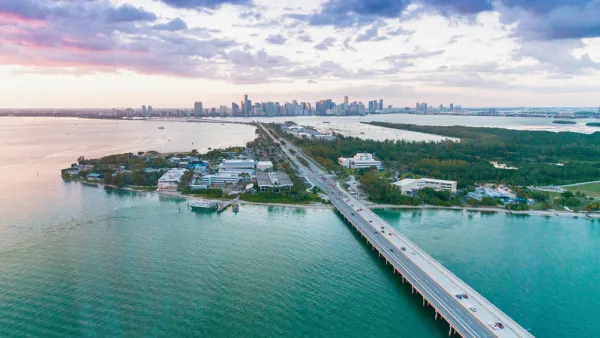
During his keynote speech on September 11 at the National Conservatism Conference in Miami, Florida Governor Ron DeSantis describes the demographic shifts in America since he became governor in 2019 in what he calls the 'Great American Exodus.'

Partisan Clustering at the Neighborhood Level
Forget red state versus blue state: a new data analysis and mapping project by The New York Times shows that the political divides in the country can be mapped to the neighborhood level within metropolitan areas.
Conservatives Have a Bad Feeling About Smart Growth
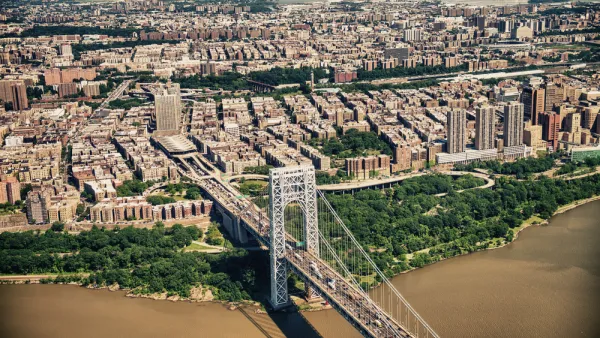
Bloggers, pundits, authors, and researchers, have made the case for conservatives to embrace the effects of smart growth. Yet still, a distinctly partisan divide flavors the debate about how to make room for a growing number of Americans.

Planetizen Federal Action Tracker
A weekly monitor of how Trump’s orders and actions are impacting planners and planning in America.

Amtrak, CN end decades-long dispute with eight-year agreement
The new operating agreement establishes an updated framework for the companies to work together, including processes to resolve disputes.

Judges permit Denver to divert 77,000 acre feet from the Colorado River for reservoir expansion
Overuse and climate change have caused the Colorado River’s water levels to plummet.

Northwest rail fans eager for Sept. 30 debut of Amtrak’s Airo fleet
Get ready for that new train smell and more seats. But they won’t go faster or run more frequently on the Cascades route in Washington and Oregon.

NYC DOT wants faster, more permanent street upgrades
The city is examining ways to build more concrete infrastructure without getting entangled in 'decades-long' projects.

'Something we’ve never seen before:' rising utility rates could strain city finances nationwide
Data centers, climate change and other factors have caused utility rates in the United States to increase by 38% since 2020.

FREE Course: Walkable City 1: Why Walkability?
After describing his path towards focusing on walkability as the essence of good planning, Jeff Speck marches through his five principal reasons for making more walkable places.
Reinventing Malls: Planning Alchemy—Turning Gray Fields Into Gold
The course focuses on the opportunities and imperatives that shape reinvention of mall sites.

Harvard University Graduate School of Design
KFH Group Inc.
Greater Baltimore Committee
The Architects Foundation
University of Cincinnati Online
The Pocatello Development Authority
The Urban Renewal Agency of the City of Pocatello