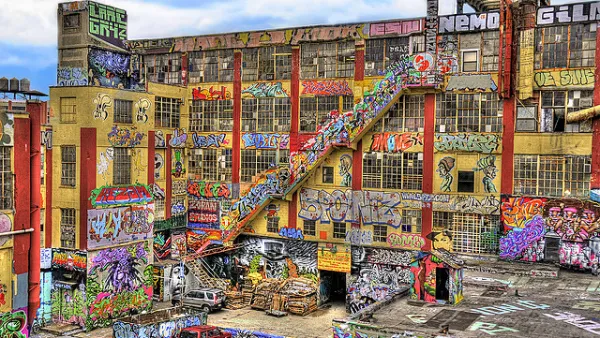
Thanks to the rising tide of redevelopment, New York's legal graffiti walls are disappearing. But the art form's pioneers rarely asked for permission to practice their art. Might the city see a return to the anarchic environment of the 1980s?


"The gradual loss of [legal graffiti] walls, like last week’s sudden whitewashing of 5Pointz in Queens, has street artists wondering where they — especially younger, less established artists — will be able to paint," writes David Gonzalez. "For J. J. Ramirez, an 'original school writer' whose tag, Mico, covered subway cars and walls starting in the late 1960s, the implications are clear."
“The whole thing boils down to class warfare,” Mr. Ramirez said. “People all over the world are wondering why they did that to 5Pointz. My answer is, why not? Do we really think some landlord is going to give a damn about the culture of the working class? This was an art form invented by the children of the working class, not children with last names like Trump or Rockefeller.”
“There are hardly any spots left in the city for graffiti writers,” Wilfredo Feliciano, 47, said. “It’s going to mean that everybody’s going to be fighting for space. And you know what happens if they don’t have space to express themselves.”
Read the full story: As Legal Graffiti Walls Disappear, Street Artists Ponder Future

Graffiti Wins Protected Legal Status in New York
A landmark judgement potentially paves the way for graffiti to be protected under the Visual Artists Rights Act.
Covert Coating Destroys NYC Street Art Mecca
In advance of its demolition to make way for a luxury condominium development, the abandoned brick warehouse turned world-renowned street art canvas known as 5Pointz was given a new coat of white paint overnight, shrouding its celebrated graffiti.
A Piece of New York's Cultural History Prepares for the Wrecking Ball
Karen McVeigh reports on 5Pointz in Long Island City, a public mecca for hip hop and graffiti artists, and its uncertain future.

Planetizen Federal Action Tracker
A weekly monitor of how Trump’s orders and actions are impacting planners and planning in America.

Amtrak, CN end decades-long dispute with eight-year agreement
The new operating agreement establishes an updated framework for the companies to work together, including processes to resolve disputes.

Judges permit Denver to divert 77,000 acre feet from the Colorado River for reservoir expansion
Overuse and climate change have caused the Colorado River’s water levels to plummet.

NYC DOT wants faster, more permanent street upgrades
The city is examining ways to build more concrete infrastructure without getting entangled in 'decades-long' projects.

'Something we’ve never seen before:' rising utility rates could strain city finances nationwide
Data centers, climate change and other factors have caused utility rates in the United States to increase by 38% since 2020.

Trump to overrule local leaders, lease millions of acres of America’s Pacific Island territories’ seafloors to mining companies
International law says that the Indigenous people of America’s territories have a right to prior and informed consent regarding projects that impact their countries.

FREE Course: Walkable City 1: Why Walkability?
After describing his path towards focusing on walkability as the essence of good planning, Jeff Speck marches through his five principal reasons for making more walkable places.
Reinventing Malls: Planning Alchemy—Turning Gray Fields Into Gold
The course focuses on the opportunities and imperatives that shape reinvention of mall sites.

Harvard University Graduate School of Design
KFH Group Inc.
Greater Baltimore Committee
The Architects Foundation
University of Cincinnati Online
The Pocatello Development Authority
The Urban Renewal Agency of the City of Pocatello