New data from the U.S. Census Bureau shows that college towns are even better at encouraging bicycle commuting than the most notable big cities (Portland, Seattle, etc); even when excluding commuting for school. What's their secret?


"Here's a secret you won't hear often: The United States has many cities where biking is far more popular than in Portland," writes Michael Andersen. "They're called college towns. And it's time for urban planners to stop ignoring how well they work and start learning from them."
College towns such as Davis (19.1%), Boulder (12.1%) and Palo Alto (9.5%) have percentages of workers commuting by bike that put cities such as Portland (6%) to shame. Andersen reviews some of the lessons that college towns can offer their big city brethren:
- Universities breed 20-minute neighborhoods
- Universities create car-free spaces
- Universities use public spaces to enable density
- Universities charge for auto parking
Read the full story: 4 things U.S. college towns could teach planners about biking

Cycling Renaissance Races Across America
From coast to coast, cities across the United States are experiencing a rise in bicycling. Local governments are leading the peloton, with cycle-friendly policies and increases in government funding spurring a municipal pedal pursuit.
Census: The Top Bike Commuting Cities In U.S.
The League of American Bicyclists updated their webpage with a link to the American Community Survey's data on bike and pedestrian commuting for the 70 largest cities and 375 more cities where data was available. Portland, OR and Davis, CA are tops.
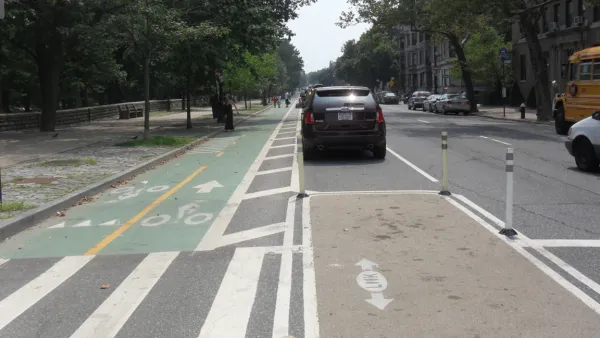
More Bicycle Infrastructure Equals More Riders
Analysis of Census data shows that, while still small in number, more Americans are taking to two-wheels as part of their daily commute.

Planetizen Federal Action Tracker
A weekly monitor of how Trump’s orders and actions are impacting planners and planning in America.

Amtrak, CN end decades-long dispute with eight-year agreement
The new operating agreement establishes an updated framework for the companies to work together, including processes to resolve disputes.

Judges permit Denver to divert 77,000 acre feet from the Colorado River for reservoir expansion
Overuse and climate change have caused the Colorado River’s water levels to plummet.

Atlanta City Council unanimously backs $3.5 billion Beltline light rail project
The resolution was drafted after Atlanta Mayor Andre Dickens pulled support for the Atlanta Streetcar extension last year.

SEPTA to bring nearby frequent transit to over 1 million new riders as part of decade-long plan
The agency's Accelerate plan will also bring frequent transit to twice the amount of jobs that are currently located near it.

NYC plants over 18,000 trees, the most new foliage in a decade
Many of the trees were planted in communities vulnerable to extreme heat.

FREE Course: Walkable City 1: Why Walkability?
After describing his path towards focusing on walkability as the essence of good planning, Jeff Speck marches through his five principal reasons for making more walkable places.
Reinventing Malls: Planning Alchemy—Turning Gray Fields Into Gold
The course focuses on the opportunities and imperatives that shape reinvention of mall sites.

City of Wisconsin Rapids
Harvard University Graduate School of Design
KFH Group Inc.
The Architects Foundation
University of Cincinnati Online
The Pocatello Development Authority
The Urban Renewal Agency of the City of Pocatello