Matthew L. Wald reports on the massive cyber war game called GridEx II that simulated a coordinated assault on America's power grid this week.


"In windowless rooms from [Washington D.C.] to California, nearly 10,000 electrical engineers, cybersecurity specialists, utility executives and F.B.I. agents furiously grappled over 48 hours with an unseen 'enemy' who tried to turn out the lights across America," writes Wald. "By late Thursday morning, in this unprecedented continental-scale war game to determine how prepared the nation is for a cyberattack, tens of millions of Americans were in simulated darkness. Hundreds of transmission lines and transformers were declared damaged or destroyed, and the engineers were rushing to assess computers that were, for the purposes of the drill, tearing their system apart."
Though participants were reluctant to discuss some of the details of the simulation and the final evaluation won't be known for weeks, the president and chief executive of the company that ran the drill was happy with the results. “It’s going really well,” said Gerry W. Cauley, of the North American Electric Reliability Corporation. “A bit scary, but really well.”
Read the full story: Coast to Coast, Simulating Onslaught Against Power Grid
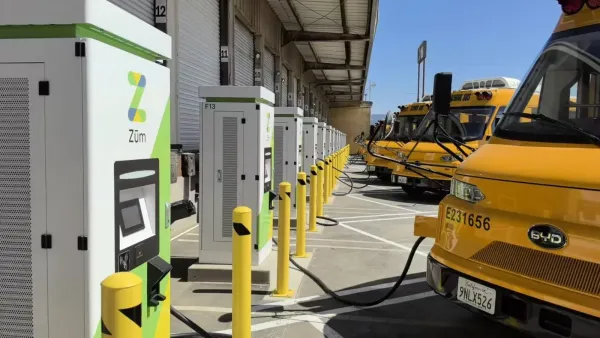
In California, electric school buses are powering 1,000 homes — and turning a profit
Tellus Power, the charging equipment manufacturer behind the project, is also helping school buses connect to the power grid in Vermont, Illinois and San Francisco.
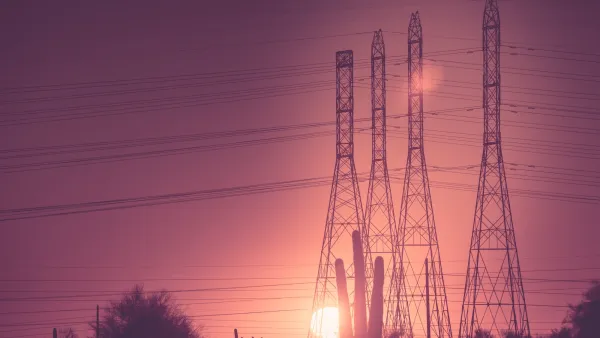
Will Tucson take back its power — literally?
One journalist's experience with a utility shutoff led them to look more closely at who provides their city’s power. It turns out there's a push for the city to buy out the investor-owned utility and create a public one.
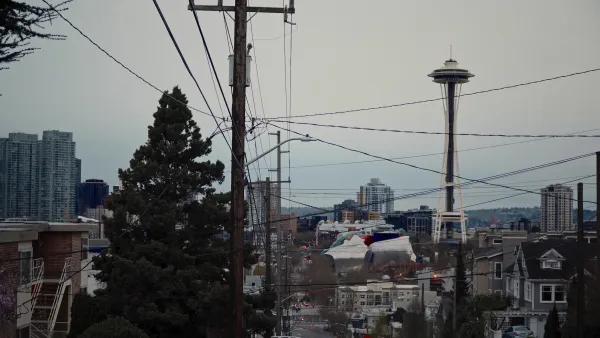
Seattle Density Increase Stymied by Underground Power Line Requirement
A new policy that requires buildings with four or more units to bury their electrical lines is making housing development more costly and causing months-long delays.

Planetizen Federal Action Tracker
A weekly monitor of how Trump’s orders and actions are impacting planners and planning in America.

California plans to bury El Niño’s downpour
If the state plays its cards right, it may be able to store a billion acre-feet of El Niño’s water in aquifers.

Desperate measures: Advocates weigh draining Lake Powell to fill Colorado River
Draining the reservoir could reduce evaporation losses by a couple hundred thousand acre-feet.

Chicago voters approve permanent festival grounds, penalty for vacant property owners
Currently, major summer and fall festivals take over public parks for weeks at a time, drawing criticism from nearby residents

NYC votes to cut outdoor dining red tape, speed up permitting
New York City also voted to allow the Department of Transportation to begin work on urgent projects before notifying elected officials.

California appears to reject Prop. 45
The proposition would have expanded the projects that qualify for a streamlined environmental review, effectively paring down the California Environmental Quality Act.

FREE Course: Walkable City 1: Why Walkability?
After describing his path towards focusing on walkability as the essence of good planning, Jeff Speck marches through his five principal reasons for making more walkable places.
Reinventing Malls: Planning Alchemy—Turning Gray Fields Into Gold
The course focuses on the opportunities and imperatives that shape reinvention of mall sites.

City of Rosemead
Rutgers University, Edward J. Bloustein School of Planning and Public Policy
One Hundred Miles
Hunter College, City University of New York (CUNY)
The Architects Foundation
University of Cincinnati Online
City of Cambridge
Montrose County
The Pocatello Development Authority