The $800 million Graton Resort & Casino will soon open in Sonoma County for the Federated Indians of the Graton Rancheria and be the closest tribal casino to San Francisco.


After winning congressional approval in 2000 to be re-established as a recognized tribe in Sonoma County, the Federated Indians of the Graton Rancheria spent more than a decade to build a casino in Rohnert Park. After reaching separate agreements with Rohnert Park, Sonoma County and the State of California, the tribe's $800 million Graton Resort & Casino, located next to Highway 101, will be closest tribal casino to San Francisco.
"Industry analysts say the new development – with 3,000 slot machines and 144 gambling tables beneath chandeliers that glitter with 24,000 pink glass flower petals – may transform gambling in California, intensifying competition among high-end resorts and the pressure to build casinos near major highways and urban centers," writes Peter Hecht.
There was much local opposition to the casino, but the tribe made improvements such as road upgrades and facade changes. “They have been good partners,” said Rohnert Park Mayor Pam Stafford, who was elected in 2006 as a staunch casino opponent. “They have been very responsible in how they worked with us to see what the impacts would be, and they have been very generous in helping financially to deal with those issues.”
Currently, there are 71 signed and ratified Tribal-State Gaming Compacts in California. Another major casino development is planned near Highway 99 in Madera County, close to Fresno and the greater San Joaquin Valley.
Read the full story: California’s Largest Casino to Open in Sonoma County
Housing Politics: Think Regionally, Lose Locally
Two Bay Area city council members serving on a regional commission suffered the political consequences of supporting a controversial regional housing initiative, not from their constituents, but from their colleagues.
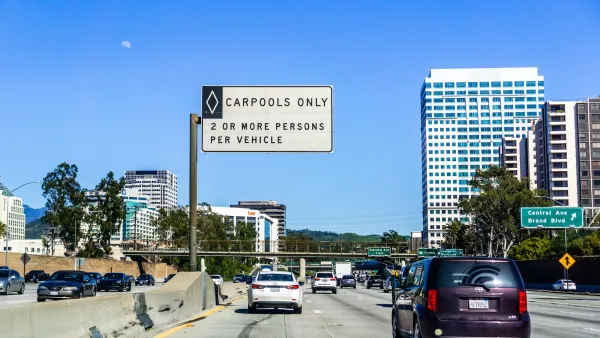
Another Reminder of the Futility of Carpool Lanes
What's the great 'fix' for the flawed Highway 101 carpool lanes in Marin and Sonoma counties in the Bay Area? Reduce the HOV time by two and a half hours during the peak commutes to enable solo drivers greater access to 52 miles of widened freeway.

When Carpool Lanes Cause Mayhem
A newly widened Bay Area freeway serves as a reminder of the futility of HOV lanes. There are better ways to manage and mitigate traffic.

Planetizen Federal Action Tracker
A weekly monitor of how Trump’s orders and actions are impacting planners and planning in America.

California plans to bury El Niño’s downpour
If the state plays its cards right, it may be able to store a billion acre-feet of El Niño’s water in aquifers.

Desperate measures: Advocates weigh draining Lake Powell to fill Colorado River
Draining the reservoir could reduce evaporation losses by a couple hundred thousand acre-feet.

Los Angeles just elected an urban planner as its mayor
Transportation analysts are optimistic that Raman will be more aggressive in addressing transit issues than Bass.

Mamdani’s pied-à-terre tax survives legal challenge
A panel of judges found that the plaintiffs failed to demonstrate injury as a result of New York City's implementation of the tax.

Eastern Nebraska is running out of electricity
Data centers and electrification are straining eastern Nebraska’s grid, throttling economic development.

FREE Course: Walkable City 1: Why Walkability?
After describing his path towards focusing on walkability as the essence of good planning, Jeff Speck marches through his five principal reasons for making more walkable places.
Reinventing Malls: Planning Alchemy—Turning Gray Fields Into Gold
The course focuses on the opportunities and imperatives that shape reinvention of mall sites.

City of Rosemead
Rutgers University, Edward J. Bloustein School of Planning and Public Policy
One Hundred Miles
University of Michigan School for Environment and Sustainability (SEAS)
Hunter College, City University of New York (CUNY)
The Architects Foundation
City of Cambridge
Montrose County
The Pocatello Development Authority