Take a ride with NPR's Jane Greenhalgh on one of "the most scenic rides in America", according to host, Steve Inskeep. Patients, staff, and visitors to Ore. Health and Science University enjoy the free, aerial tram ride to the top of a Portland hill.


Join Greenhalgh, Senior Producer of Science Desk for National Public Radio, as she "glide(s) up 500 feet in the air in a gleaming silver gondola for a 3,300-feet, three-minute sky tram ride with beautiful views" of Portland to Oregon Health and Science University on the summit of Marquam Hill, the state's only academic health center and Portland's largest employer. [Listen here.]
Access to OHSU, a 125-year old institution, has been limited by the windy, two-lane road, and once they arrived, parking is limited, so planners considered alternatives.
They considered a streetcar, a dedicated express bus lane, even a tunnel, but Mark Williams, vice president of campus development, says by far the best option was the sky tram, which opened in 2007. It's linked to the city and surrounding suburbs by an extensive public transportation system. Commuters have several ways to get here. They can drive and park, take the light rail to the streetcar (which stops just feet from the tram), walk or bike.
And bike they do. Greenhalgh speaks with neuroscience student Nora Hammock, one of 170 cyclists that valet parking operator, Kiel Johnson, had parked this morning, free of charge.
"It's the best. It's so lovely to be able to ride up and drop my bike off," Hammock says. "It's safe and dry the whole time, and I get to ride to work in one of the most unique transportation systems."
With limited parking on campus, the tram showcases how off-site parking works with public transit to provide access to a dense work site.
But down at the bottom of the hill, just on the other side of Interstate 5, is a big swath of flat land perfect for parking and for the medical center's expansion. All that was needed was a quick way to get people up and down.
Finally, you will not hear, "Watch the closing doors, please" on this tram ride. Instead, listen for "As we pass the tower, we will swing...watch your balance..."
Check out other aerial tram systems in the world, either operating or proposed, posted here from London, Hamburg, Rio de Janeiro, and New York.
Read the full story: How To Solve A Sky-High Commuting Conundrum
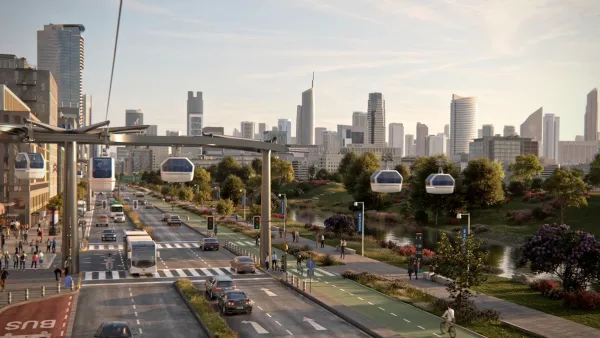
Anaheim Proposes Gondola Connecting Disneyland, Stadiums, Transit Center
The as-yet-unfunded project would connect major attractions along the city’s main artery.
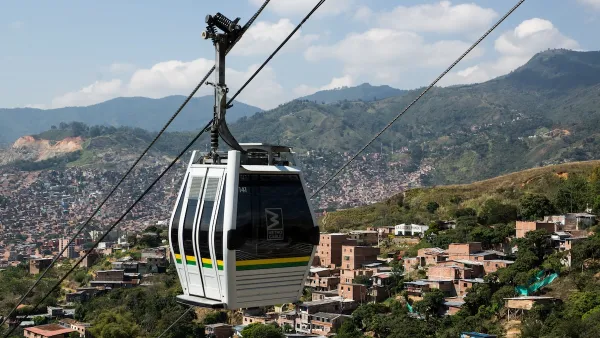
In U.S., Urban Gondolas Face Uphill Battle
Cities in Latin America and Europe have embraced aerial transitways — AKA gondolas — as sustainable, convenient urban transport, especially in tricky geographies. American cities have yet to catch up.

Mexico City Aerial ‘Cablebus’ Provides Key Connection to Peripheral Neighborhoods
Unlike many aerial gondolas, Mexico City’s Cablebus is largely used by commuters and residents from communities farther from the city center.

Planetizen Federal Action Tracker
A weekly monitor of how Trump’s orders and actions are impacting planners and planning in America.

California plans to bury El Niño’s downpour
If the state plays its cards right, it may be able to store a billion acre-feet of El Niño’s water in aquifers.

Desperate measures: Advocates weigh draining Lake Powell to fill Colorado River
Draining the reservoir could reduce evaporation losses by a couple hundred thousand acre-feet.

Housing is the top priority of Seattle’s sole new councilmember
Jenks campaigned on building 1,000 new units of affordable housing.

New tax cuts may slash $1.5 billion in funding for Miami transit, public parks
Amendment 3 will save Miami-Dade homeowners $2,700 in 2028.

Arizona, Wisconsin, Pennsylvania hope to finally advance climate goals post-midterms
The three states have spent years under Republican or divided control.

FREE Course: Walkable City 1: Why Walkability?
After describing his path towards focusing on walkability as the essence of good planning, Jeff Speck marches through his five principal reasons for making more walkable places.
Reinventing Malls: Planning Alchemy—Turning Gray Fields Into Gold
The course focuses on the opportunities and imperatives that shape reinvention of mall sites.

City of Rosemead
Rutgers University, Edward J. Bloustein School of Planning and Public Policy
One Hundred Miles
University of Michigan School for Environment and Sustainability (SEAS)
Hunter College, City University of New York (CUNY)
The Architects Foundation
City of Cambridge
Montrose County
The Pocatello Development Authority