As urban areas across the country compete for those coveted young professionals, "unhip" suburbs have a particularly tough challenge. In Montgomery County, MD, a taskforce has issued its recommendations for addressing this challenge.


"Later closing times for bars, relaxation of noise ordinances and a 'concierge' service to help new businesses maneuver the Montgomery County bureaucracy are among the proposals of a task force charged with lifting the hipness quotient of a place many millennials find bland and inhospitable," reports Bill Turque.
"For six months, the 21-member group has discussed tweaking public policy to make the county — specifically Silver Spring, Bethesda, Wheaton, Rockville and Germantown — competitive with places such as the District and Arlington County as destinations for the young. Panel members hope that its series of 33 proposals, finalized at a meeting Monday evening, will let a thousand food trucks, brew pubs and live music venues bloom."
Read the full story: Montgomery considers lifting hipness quotient with later bar hours, ‘noise areas’

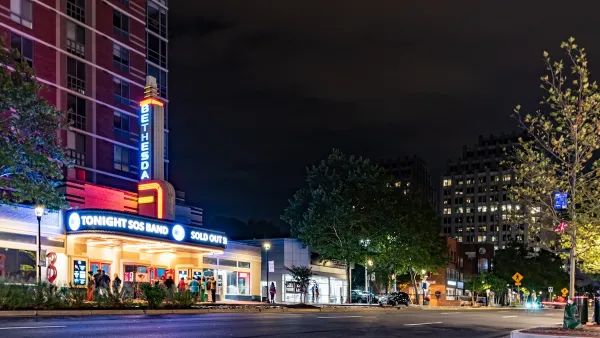
Opinion: Montgomery County Regulations Stifle Nightlife
The county hasn’t acted on the recommendations of its own Nighttime Economy Task Force, which suggested ways to improve the business climate for restaurants and nightclubs to draw younger residents to the region.
More Towns Mimicking New Orleans and Allowing Public Drinking
It used to be that only New Orleans and Las Vegas allowed people to carry a drink outdoors and imbibe in public. Now cities all over the country, mostly in traditionally conservative states, are loosening their laws.

Millennial Invasion Creates a "New Washington"
Drawn by plentiful jobs and an improving quality of life, millennials helped swell D.C.'s population over the last decade - to the delight of some and dismay of others. In a series of articles, The Post chronicles the city's "millennials moment".

Planetizen Federal Action Tracker
A weekly monitor of how Trump’s orders and actions are impacting planners and planning in America.

Amtrak, CN end decades-long dispute with eight-year agreement
The new operating agreement establishes an updated framework for the companies to work together, including processes to resolve disputes.

Judges permit Denver to divert 77,000 acre feet from the Colorado River for reservoir expansion
Overuse and climate change have caused the Colorado River’s water levels to plummet.

Maryland local governments examine if they should have more power to raise property taxes
Maryland’s housing market is out of reach for the majority of moderate-income residents.

Northwest rail fans eager for Sept. 30 debut of Amtrak’s Airo fleet
Get ready for that new train smell and more seats. But they won’t go faster or run more frequently on the Cascades route in Washington and Oregon.

NYC DOT wants faster, more permanent street upgrades
The city is examining ways to build more concrete infrastructure without getting entangled in 'decades-long' projects.

FREE Course: Walkable City 1: Why Walkability?
After describing his path towards focusing on walkability as the essence of good planning, Jeff Speck marches through his five principal reasons for making more walkable places.
Reinventing Malls: Planning Alchemy—Turning Gray Fields Into Gold
The course focuses on the opportunities and imperatives that shape reinvention of mall sites.

Harvard University Graduate School of Design
KFH Group Inc.
Greater Baltimore Committee
The Architects Foundation
University of Cincinnati Online
The Pocatello Development Authority
The Urban Renewal Agency of the City of Pocatello