Though vehicular deaths have been declining across the U.S., pedestrian and cyclist deaths have risen. While intuition might say our ubiquitous cell phones are to blame, hard data has been scarce. A new study seems to support this conclusion.


According to Angie Schmitt, "a new study published in Public Health Reports, the journal of the U.S. Public Health Service and the Office of the U.S. Surgeon General, reveals that distracted driving — particularly driving while texting — partially explains the rising [pedestrian and cyclist] death toll."
"A research team from the University of Nebraska Medical Center examined crash records from every fatal collision tracked by the Fatality Analysis Reporting System between 2005 and 2010," she notes. "They found that the rate of bike and pedestrian fatalities in which distracted driving was listed as a factor increased sharply over that time period."
"Distracted driving was defined to include anything from tending to a child to tuning the radio or eating while driving," Schmitt explains. "Cell phone use was a major culprit, cited by police in 18.6 percent of the distracted driving deaths involving pedestrians and cyclists."
Read the full story: Distracted Driving Is Claiming the Lives of More Pedestrians and Cyclists
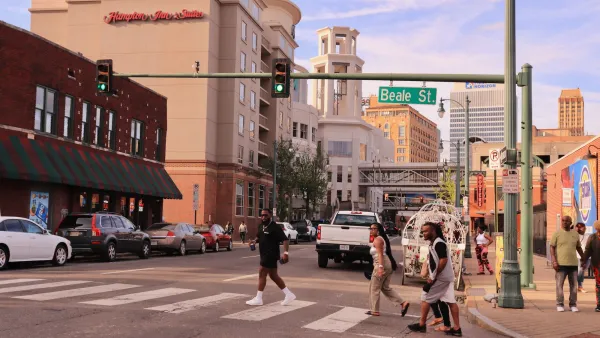
Memphis is the nation's most dangerous city for pedestrians
Memphis had the highest rate of traffic deaths for people walking in the US for two years in a row.
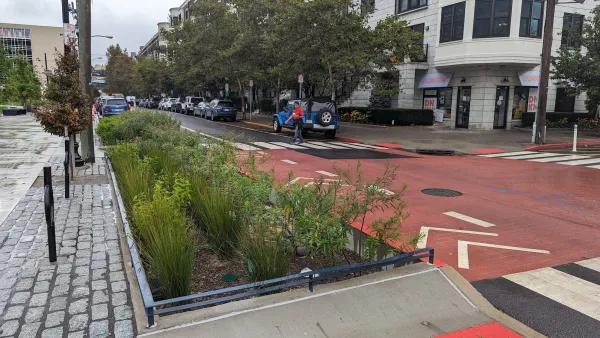
Hoboken's $20 Vision Zero fix
The New Jersey city eliminated traffic deaths for the last nine years in a row.
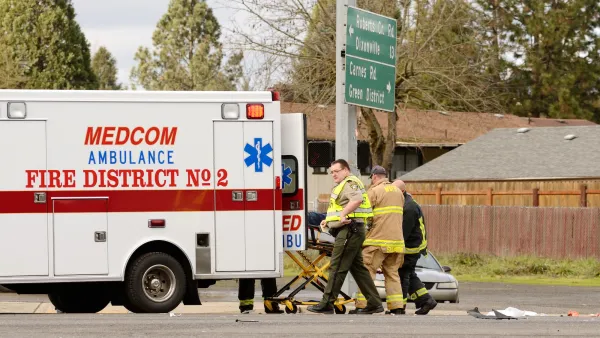
'Dangerous by Design' 2026 report highlights 72% increase in pedestrian deaths since 2009
Although US traffic deaths dropped in the last two years, the number of people killed on US roads remains much higher than two decades ago.

Planetizen Federal Action Tracker
A weekly monitor of how Trump’s orders and actions are impacting planners and planning in America.

California plans to bury El Niño’s downpour
If the state plays its cards right, it may be able to store a billion acre-feet of El Niño’s water in aquifers.

Desperate measures: Advocates weigh draining Lake Powell to fill Colorado River
Draining the reservoir could reduce evaporation losses by a couple hundred thousand acre-feet.

Mamdani’s pied-à-terre tax survives legal challenge
A panel of judges found that the plaintiffs failed to demonstrate injury as a result of New York City's implementation of the tax.

Eastern Nebraska is running out of electricity
Data centers and electrification are straining eastern Nebraska’s grid, throttling economic development.

Seattle passes record-breaking transit services expansion
Proposition 1 will double the city’s transit tax to add 95,000 more bus trips and preserve 180,000 bus trips annually.

FREE Course: Walkable City 1: Why Walkability?
After describing his path towards focusing on walkability as the essence of good planning, Jeff Speck marches through his five principal reasons for making more walkable places.
Reinventing Malls: Planning Alchemy—Turning Gray Fields Into Gold
The course focuses on the opportunities and imperatives that shape reinvention of mall sites.

City of Rosemead
Rutgers University, Edward J. Bloustein School of Planning and Public Policy
One Hundred Miles
University of Michigan School for Environment and Sustainability (SEAS)
Hunter College, City University of New York (CUNY)
The Architects Foundation
City of Cambridge
Montrose County
The Pocatello Development Authority