Add a list of the "Top 100 Best Places to Live" to the seemingly endless series of rankings seeking to quantify what's best and worst about our cities and states. Though the inputs have changed over the last 80 years, our desire to rank hasn't.


With the help of Matt Carmichael, editor of the website Livability.com (the producer of the Best Places to Live list), Emily Badger goes back to a three-part series on "THE WORST AMERICAN STATE" by H.L. Mencken that ran in The American Mercury in 1931 to trace our fascination with ranking places.
"Over time, 'quality of life' – or, more often today, 'livability' – has come to mean many things, some of them contradictory, others just outdated," she observes. "One theme that remains constant dating back to Mencken's time is that even as the criteria have changed, our search to quantify the unquantifiable has not."
"Listicles and rankings since 1931 have benefited from ever-more data, and now an ever-more insatiable appetite to rank everything," she continues. "Rankings themselves have proliferated – creating an endless list of lists to which Carmichael is conscious that he's adding yet one more entry."
Oh, and in case you're interested (of course you are), Palo Alto came in first in Carmichael's Top 100 Best Places to Live rankings.
Read the full story: The Neverending Evolution of 'Quality of Life' Rankings
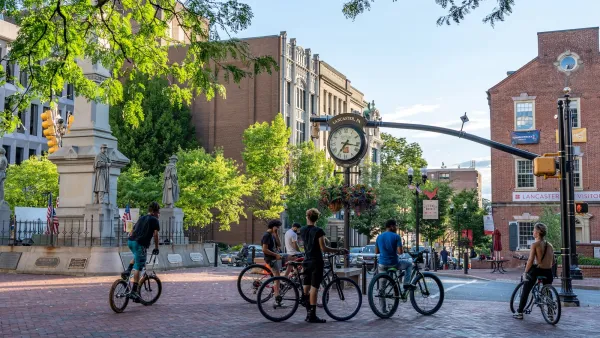
The Nation’s Best Small Cities Ranked by Livability, Affordability
A new list looks at a range of factors from housing costs to entertainment to commute times to rank the most attractive small cities in the U.S.
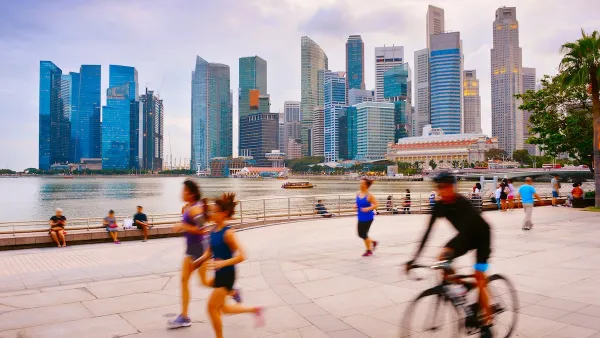
Singapore: A Model for Longevity and Quality of Life
Singapore's remarkable rise in life expectancy, driven by government policies on health, green spaces, and social cohesion, has earned it the distinction of being named the world's sixth “Blue Zone.”

Insights From the Latest Livability Index
The latest edition of the AARP Livability Index reveals the U.S. regions with more of the kinds of neighborhoods that offer quality of life benefits for residents of all ages.

Planetizen Federal Action Tracker
A weekly monitor of how Trump’s orders and actions are impacting planners and planning in America.

Eastern Nebraska is running out of electricity
Data centers and electrification are straining eastern Nebraska’s grid, throttling economic development.

Study reveals best places in the U.S. for cycling, walking
New research from Streetlight Data examines bicycle and pedestrian miles per capita in the 100 largest U.S. cities by population.

DSA members accuse Mamdani of 'abandoning values' over housing redevelopment
New York City's mayor plans to replace about 2,000 units of public housing with private, mixed-income housing.

All sides of BRT debate unhappy with CDOT’s most recent move
The Colorado Department of Transportation is no longer considering center-running bus lanes for Colorado Boulevard.

Massachusetts bogs generate both power, and cranberries
Putting solar panels above farmland is one way Massachusetts is advancing toward its goal of net-zero carbon emissions by 2050.

FREE Course: Walkable City 1: Why Walkability?
After describing his path towards focusing on walkability as the essence of good planning, Jeff Speck marches through his five principal reasons for making more walkable places.
Reinventing Malls: Planning Alchemy—Turning Gray Fields Into Gold
The course focuses on the opportunities and imperatives that shape reinvention of mall sites.

City of Rosemead
Rutgers University, Edward J. Bloustein School of Planning and Public Policy
One Hundred Miles
University of Michigan School for Environment and Sustainability (SEAS)
Hunter College, City University of New York (CUNY)
The Architects Foundation
City of Cambridge
The Pocatello Development Authority
The Urban Renewal Agency of the City of Pocatello